How to make cauliflower rice that is fluffy, not mushy
How to make cauliflower rice with a box grater or food processor, cook it dry in a skillet or roast it, season it, freeze it and avoid mushy, watery rice.
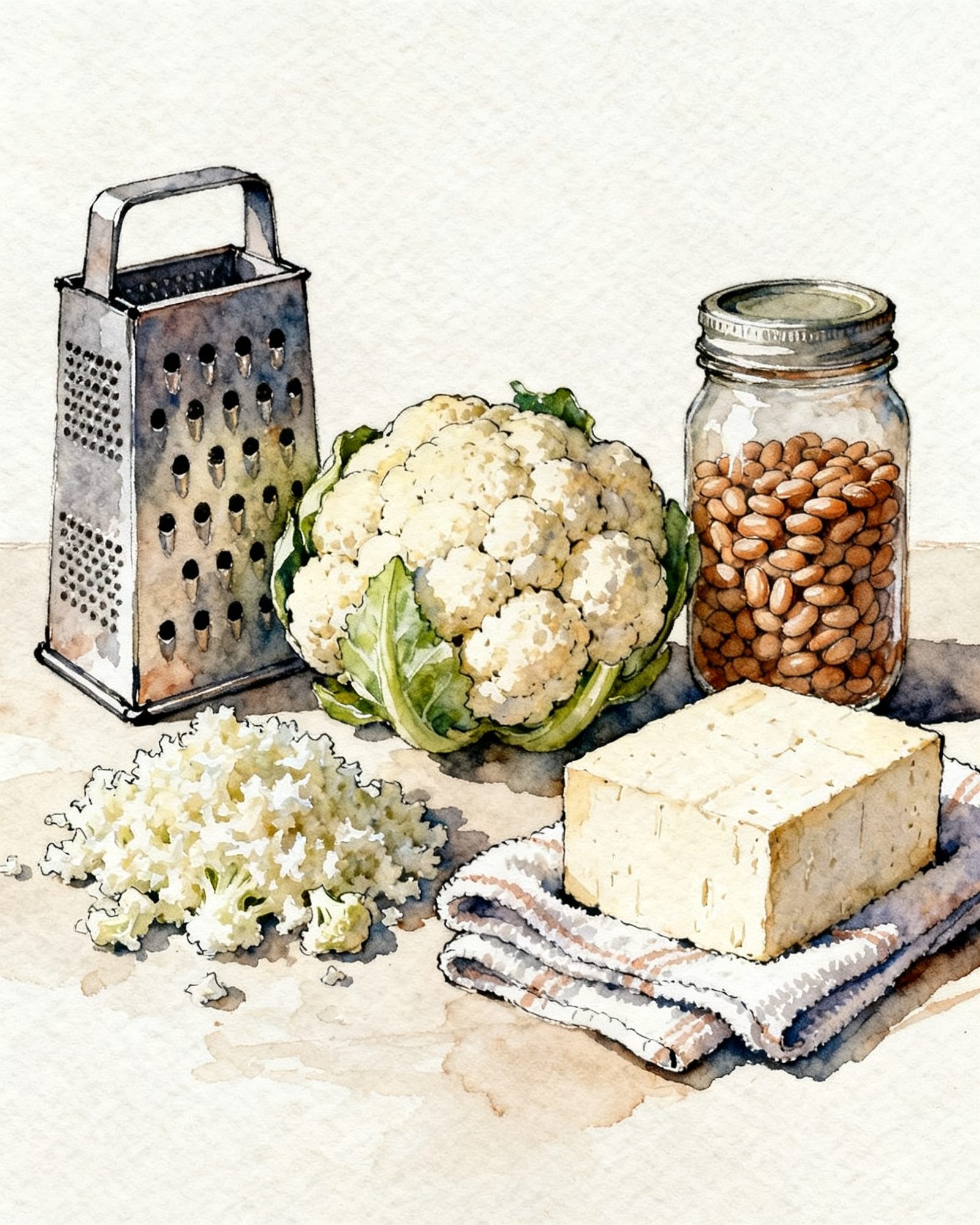
Makes About 3 1/2 cups, 4 servings
Ingredients
- 1 head (about 590 g) cauliflower, 5 to 6 inches across
- 1 tbsp olive oil
- 1/2 tsp fine salt, plus more to taste
- 1/8 tsp ground black pepper
To serve
- 2 tbsp chopped fresh parsley (optional)
Equipment
- Food processor or box grater
- Large bowl
- 12-inch skillet (or a large rimmed baking sheet for the oven method)
- Clean kitchen towels
Method
Pull off the green leaves, cut the cauliflower head into quarters through the core, and cut the core out of each quarter. Break or cut the quarters into florets about 1 1/2 inches across. Rinse them under cold running water, then dry them thoroughly in a clean kitchen towel: florets that go in wet make wet rice.
Food processor: fill the bowl no more than half full and pulse in short bursts, 10 to 15 times, until most of the pieces are the size of rice grains. Tip them into a bowl, pick out any large chunks to add to the next batch, and repeat with the rest. Box grater: grate each floret on the large holes, holding it by the stem, and stop when you reach the stem.
Spread the rice on a second clean kitchen towel and press gently to blot off surface moisture.
Heat the olive oil in a 12-inch skillet over medium-high heat until it shimmers. Add the cauliflower rice in an even layer and cook uncovered, stirring every 1 to 2 minutes, until it is tender with a slight bite and some grains are lightly golden, 5 to 7 minutes. Do not cover the pan or add water.
Take the pan off the heat, add the salt and pepper, and toss. Taste, add more salt if needed, and serve sprinkled with parsley if you like. Refrigerate leftovers within 2 hours.
Oven method, instead of the skillet: heat the oven to 425°F (220°C), toss the rice with the oil on a large rimmed baking sheet, spread it in a thin layer, and roast until dry and lightly golden at the edges, 15 to 20 minutes, stirring once halfway. Season as in the step above. This takes about 10 minutes longer than the skillet.
Nutrition per serving
| Calories | 70 |
|---|---|
| Total fat | 4 g |
| Saturated fat | 0.5 g |
| Carbohydrate | 7 g |
| Fiber | 3 g |
| Total sugars | 3 g |
| Protein | 3 g |
| Sodium | 340 mg |
| Calcium | 30 mg |
| Iron | 0.6 mg |
Per serving, calculated from USDA FoodData Central values for the ingredients and amounts listed, leaving out the optional ingredients. Calories, fat, carbohydrate, fiber, sugars, protein and sodium are rounded with the FDA Nutrition Facts label rules; calcium is shown to the nearest 10 mg and iron to the nearest 0.1 mg. Brands differ, so treat the figures as estimates.
How these numbers were calculated
Each ingredient as weighed for the calculation and the USDA FoodData Central record its nutrients come from. Where USDA has no record for an ingredient (vegan butter, nutritional yeast, coconut sugar), the closest generic record is used and named here.
| Ingredient | Grams | USDA record |
|---|---|---|
| 1 head (about 590 g) cauliflower, 5 to 6 inches across | 588 g | FDC 169986: Cauliflower, raw (SR Legacy). Weight from: USDA portion '1 head medium (5-6" dia.)' |
| 1 tbsp olive oil | 13.5 g | FDC 171413: Oil, olive, salad or cooking (SR Legacy). Weight from: USDA portion '1 tablespoon' |
| 1/2 tsp fine salt, plus more to taste | 3 g | FDC 173468: Salt, table (SR Legacy). Weight from: USDA portion '1 tsp' |
| 1/8 tsp ground black pepper | 0.3 g | FDC 170931: Spices, pepper, black (SR Legacy). Weight from: USDA portion '1 tsp, ground' |
| 2 tbsp chopped fresh parsley (optional) | not counted (optional) | FDC 170416: Parsley, fresh (SR Legacy). Weight from: USDA portion '1 tbsp' |
Cauliflower rice is raw cauliflower broken down into pieces the size of rice grains and cooked quickly in a hot pan, where it turns tender, slightly sweet and loose enough to spoon like rice. It takes one head of cauliflower, a grater or food processor and about 25 minutes from start to finish. The method on the card above is built around one idea: cauliflower is full of water, and every step, from drying the florets to cooking in an open pan and salting at the end, is there to get rid of that water so the grains stay separate instead of turning into mush.
Preparing the head
Choose a firm, heavy head with tight, creamy-white florets and no soft brown spots. Pull off the leaves, cut the head into quarters through the core and cut the hard core out of each quarter; then break the quarters into florets about 1 1/2 inches across, which fit easily into a food processor or are easy to hold against a grater.
The FDA does not recommend washing fruits and vegetables with soap, detergent or commercial produce wash, and it advises washing your hands for at least 20 seconds with soap and warm water before and after preparing produce. Rinse the florets, then dry them thoroughly: roll them in a clean kitchen towel or spin them in a salad spinner. Wet florets clump in the processor, and the water they carry into the pan has to cook off before anything else can happen.
Grater or food processor
Food processor. The fastest way to rice a whole head. Fill the bowl no more than half full, because an overfilled bowl processes unevenly: the bottom turns to purée while the top is still in chunks. Pulse in short bursts, 10 to 15 times, and stop when most of the pieces look like rice grains. Tip them out, pick out any large pieces and add them to the next batch. A grating disc also works and gives longer, more uniform shreds.
Box grater. Use the large holes and hold each floret by its stem, grating the top until you reach the stem. Grating is slower and messier, but the grains come out very even and fluffy, and it is almost impossible to over-process. It is the better choice if you only need half a head.
The leftover core and stems are edible. Grate them too, or slice them for a stir-fry or soup.
After ricing, spread the rice on a second clean towel and press gently to blot off the surface moisture.
A medium head gives roughly 5 cups of raw rice, which cooks down to the card’s 3 1/2 cups. A 1-pound bag of store-bought riced cauliflower is about 4 cups raw, a little less than one head.
Why an open, hot pan matters
In a hot skillet with a thin film of oil, the moisture that cauliflower releases evaporates as soon as it hits the pan, and the grains fry lightly and pick up a few golden spots. Put a lid on, or crowd the pan, and that moisture stays put: the cauliflower steams in its own liquid and turns soft and wet. A 12-inch skillet holds one head of riced cauliflower in a fairly even layer; with a smaller pan, cook it in two batches.
Salt goes in after cooking for the same reason. Salt draws water out of vegetables, so salting at the start pulls liquid into the pan just when you are trying to drive it off. Season off the heat and toss.
How to tell when it is done
Cauliflower rice is done after 5 to 7 minutes in the skillet, when:
- the grains are tender but still have a slight bite, like al dente rice;
- some grains are lightly golden;
- the raw, cabbage-like smell has given way to a sweet, nutty one;
- the bottom of the pan is dry when you push the rice aside.
Go much past this and the pieces start to collapse. It keeps cooking for a minute after you take it off the heat, so pull it when it is just tender.
Roasting instead of pan-cooking
The oven method on the card suits a big batch or a busy stovetop. At 425°F (220°C), spread thin on a large rimmed sheet, the rice dries and browns at the edges in 15 to 20 minutes with one stir halfway. It takes about 10 minutes longer than the skillet but needs only that one stir, and the roasted flavor is a little deeper. Do not pile it up: a thick layer steams.
Microwave, air fryer and pressure cooker
Microwave. Spread the rice in a wide, shallow microwave-safe dish, uncovered, with a teaspoon of oil or none at all. Cook on high in 1-minute bursts, stirring between each, until it is tender with a slight bite, usually a few minutes for half a head. Covering it or adding water steams it soft, so leave it open and drain off any liquid before seasoning. It does not brown, but it is the fastest method.
Air fryer. Toss the rice with the oil and cook it in a thin layer on a high setting, shaking the basket every few minutes, until dry and golden at the edges. The basket holds less than a skillet, so a whole head needs two or three batches; a crowded basket steams.
Electric pressure cooker or rice cooker. Not a good fit. Both cook with trapped steam, which is exactly what makes cauliflower rice wet and mushy, and there is nothing to absorb, because cauliflower is not a grain. Use the pressure cooker for very soft florets to blend into cauliflower mash instead.
Cauliflower rice compared with rice and quinoa
Cauliflower rice is a vegetable used like a grain, and the numbers show how different it is. The table compares one cup of raw cauliflower with one cup of cooked white rice, brown rice and quinoa. USDA gives the weight of a cup of chopped cauliflower, which is close to a cup of riced cauliflower: a 1-pound bag holds about 4 cups.
| Food | Amount | Calories | Carbs | Fiber | Protein | USDA record |
|---|---|---|---|---|---|---|
| Cauliflower, raw (riced, before cooking) | 1 cup, chopped (107 g) | 27 | 5.3 g | 2.1 g | 2.1 g | FDC 169986 |
| White rice, long-grain, cooked | 1 cup (158 g) | 205 | 45 g | 0.6 g | 4.3 g | FDC 168878 |
| Brown rice, long-grain, cooked | 1 cup (202 g) | 248 | 52 g | 3.2 g | 5.5 g | FDC 169704 |
| Quinoa, cooked | 1 cup (185 g) | 222 | 39 g | 5.2 g | 8.1 g | FDC 168917 |
Calculated from USDA FoodData Central: the nutrient values per 100 g of each record, scaled to the gram weight USDA lists for the amount shown. Brands and varieties differ.
Two things to keep in mind when reading it. The cauliflower is shown raw, and cooking drives off water, so a cup of cooked cauliflower rice is a little denser than a cup of raw, and the oil on the card adds fat and calories; the card above gives the figures for this recipe as cooked. And the comparison is per cup, not per gram: a cup of cooked grains weighs more than a cup of riced cauliflower.
It also behaves differently in a dish. Rice absorbs liquid and releases starch; cauliflower does neither. That makes cauliflower rice good under saucy stews and curries and in fried-rice style dishes, but it will not turn creamy like risotto, will not stick together for sushi or rice balls, and does not swell when simmered in broth. For a sticky or creamy dish, mix it half and half with cooked rice.
What it tastes like
Cooked cauliflower rice tastes mild, slightly sweet and a little nutty, with a faint cabbage-family note that browning reduces. It is softer and more delicate than rice, with a tender-crisp bite rather than a chewy one. It will not pass for rice on its own, but under a well-seasoned sauce the difference is mostly in texture.
Seasoning ideas
The card uses only salt and pepper so it can go with anything. To flavor it, add these to the skillet as noted:
- Garlic and herb: a minced garlic clove in the oil for the last minute of cooking, then chopped parsley and a squeeze of lemon off the heat.
- Cilantro-lime: lime juice and chopped cilantro off the heat, for bowls and tacos.
- Cumin and turmeric: a pinch of each in the oil before the cauliflower goes in, for a golden rice to serve with lentils or chickpeas.
- Fried-rice style: cook diced carrot, frozen peas and green onion first, add the cauliflower, then season with soy sauce instead of salt, and finish with toasted sesame oil. For the scrambled-egg element, crumble in pressed firm tofu browned in the pan first.
- Pilaf-style: cook a finely diced small onion in the oil until golden before adding the cauliflower, then finish with toasted slivered almonds, chopped parsley and lemon zest.
- Mexican-style: add 1/2 teaspoon each of ground cumin and chili powder to the oil, and stir in a few spoonfuls of drained salsa and chopped cilantro off the heat.
How to use it
Cauliflower rice goes wherever rice would, and it soaks up sauces well. It is the base of the filling in stuffed peppers with cauliflower rice, where it is cooked dry and mixed with black beans and corn. Spoon a stew such as chickpea ratatouille over it, or use it in grain bowls with roasted vegetables and a dressing. Cauliflower mash, as in baked BBQ tofu with cauliflower mash, is a different preparation: the florets are cooked until very soft and blended smooth rather than riced.
Storing, freezing and store-bought frozen rice
Raw riced cauliflower: keep it in a covered container in the refrigerator and cook it soon, while it still smells fresh and sweet; riced cauliflower loses quality faster than a whole head. Throw it out if it smells sour or feels slimy. The FDA advises storing perishable fresh vegetables at 40°F or below and refrigerating all produce bought pre-cut or packaged, which includes store-bought fresh cauliflower rice.
Cooked cauliflower rice: refrigerate it within 2 hours of cooking, the limit USDA’s Food Safety and Inspection Service gives for leftovers, and eat it within 3 to 4 days. Reheat it in a hot skillet or the microwave until it reaches 165°F.
Freezing: spread raw riced cauliflower on a sheet pan, freeze it until firm, then transfer it to a freezer bag and press out the air; frozen loose like this, it pours out in portions instead of setting into one block. FoodSafety.gov notes that freezer storage times are for quality only and that food stored continuously at 0°F or below can be kept indefinitely, but frozen vegetables slowly dry out and lose flavor. Raw cauliflower frozen without blanching tends to lose flavor and color sooner than blanched vegetables, so use homemade frozen rice fairly soon for the best taste and texture.
Store-bought frozen cauliflower rice: cook it from frozen in a hot skillet, uncovered, and expect it to release more water than fresh. Keep stirring until the liquid has evaporated, then season. Thawing it first turns it soggy.
Common mistakes and how to fix them
- Mushy rice: the florets went in wet, the pan was covered or crowded, or it cooked too long. Dry well, cook uncovered in an even layer in a pan big enough for the batch, and stop at tender-crisp.
- Watery rice: salt went in too early, or frozen rice went into a pan that was not hot enough. Turn the heat up and keep cooking uncovered until the pan is dry.
- Over-pulsed, pasty bits: the processor bowl was too full or the pulses too long. Process in smaller batches with short pulses. Over-processed cauliflower is still good in soups or in a cauliflower mash.
- Uneven pieces: big chunks were not picked out between batches. Sort them out and re-pulse them with the next batch.
- Bland flavor: cauliflower is mild, so it needs the full measure of salt and something bright or savory, such as lemon, herbs or garlic.
Allergy and ingredient notes
The base recipe contains none of the common allergens named here: no tree nuts, peanuts, soy, wheat or gluten, sesame or coconut; it is made with gluten-free ingredients; check labels for cross-contact. The pilaf-style variation adds tree nuts (almonds). The fried-rice variation adds soy and sesame, and most soy sauce also contains wheat; use a soy sauce labeled gluten-free if you avoid wheat, and check labels for cross-contact. If you cook it in coconut oil instead of olive oil, the dish contains coconut.
Common questions
Is it better to grate cauliflower or use a food processor?
A food processor is faster and less messy, especially for a whole head, but it is easy to overdo: pulse in short bursts with the bowl no more than half full. A box grater gives very even, fluffy grains and is hard to overwork, but it takes longer and scatters bits around the counter.
Why is my cauliflower rice mushy?
The usual causes are florets that were wet when riced, a covered pan that trapped steam, a crowded pan, or cooking too long. Dry the florets well, cook the rice uncovered in an even layer in a hot 12-inch skillet (or in two batches in a smaller pan), and stop as soon as it is tender with a slight bite.
Do you have to cook cauliflower rice?
No. Raw riced cauliflower is crunchy and works in salads and grain-style bowls. Cooking makes it softer, sweeter and more like rice. Rinse whole florets under running water before ricing either way.
How do you cook frozen cauliflower rice?
Straight from the freezer, in a hot skillet with a little oil, uncovered. It releases more water than fresh, so keep stirring until the ice has melted, the liquid has evaporated and the pan looks dry, then season. Thawing it first makes it soggy.
How long does cooked cauliflower rice keep in the fridge?
Refrigerate it within 2 hours of cooking and eat it within 3 to 4 days, the window USDA's Food Safety and Inspection Service gives for leftovers. Reheat it in a skillet or microwave until it reaches 165°F.
Does cauliflower rice taste like rice?
Not really. It tastes mild, slightly sweet and a little nutty, and its texture is tender-crisp rather than chewy. Under a well-seasoned sauce or in a fried-rice style dish the difference is mostly in texture, which is why it works best with bold flavors.
Sources
Read next
Banana nice cream, plus a blue spirulina version
How to turn frozen bananas into smooth soft-serve: ripeness, slicing and freezing, blending with almost no liquid, a blue spirulina version and more flavors.
Vegan butter pecan ice cream with caramel
Dairy-free butter pecan ice cream: pecans toasted in vegan butter, a brown sugar coconut-milk base and a cold coconut caramel swirl. Churned or no-churn.
Vegan chocolate chip cookies: chewy, golden, no eggs
Chewy vegan chocolate chip cookies made with vegan butter and no eggs: why brown sugar and chilling matter, when to pull them, ice cream sandwiches, freezing.
Vegan pistachio ice cream
A coconut-milk pistachio ice cream with real pistachio flavor and no green dye: blending the nuts, a chilled base that churns smooth, plus a no-churn method.
Stuffed peppers with cauliflower rice and black beans
Vegan stuffed peppers with a spiced filling of cauliflower rice, black beans, corn and tomato: par-baked halves, a filling that stays dry, make-ahead tips.