Banana nice cream, plus a blue spirulina version
How to turn frozen bananas into smooth soft-serve: ripeness, slicing and freezing, blending with almost no liquid, a blue spirulina version and more flavors.
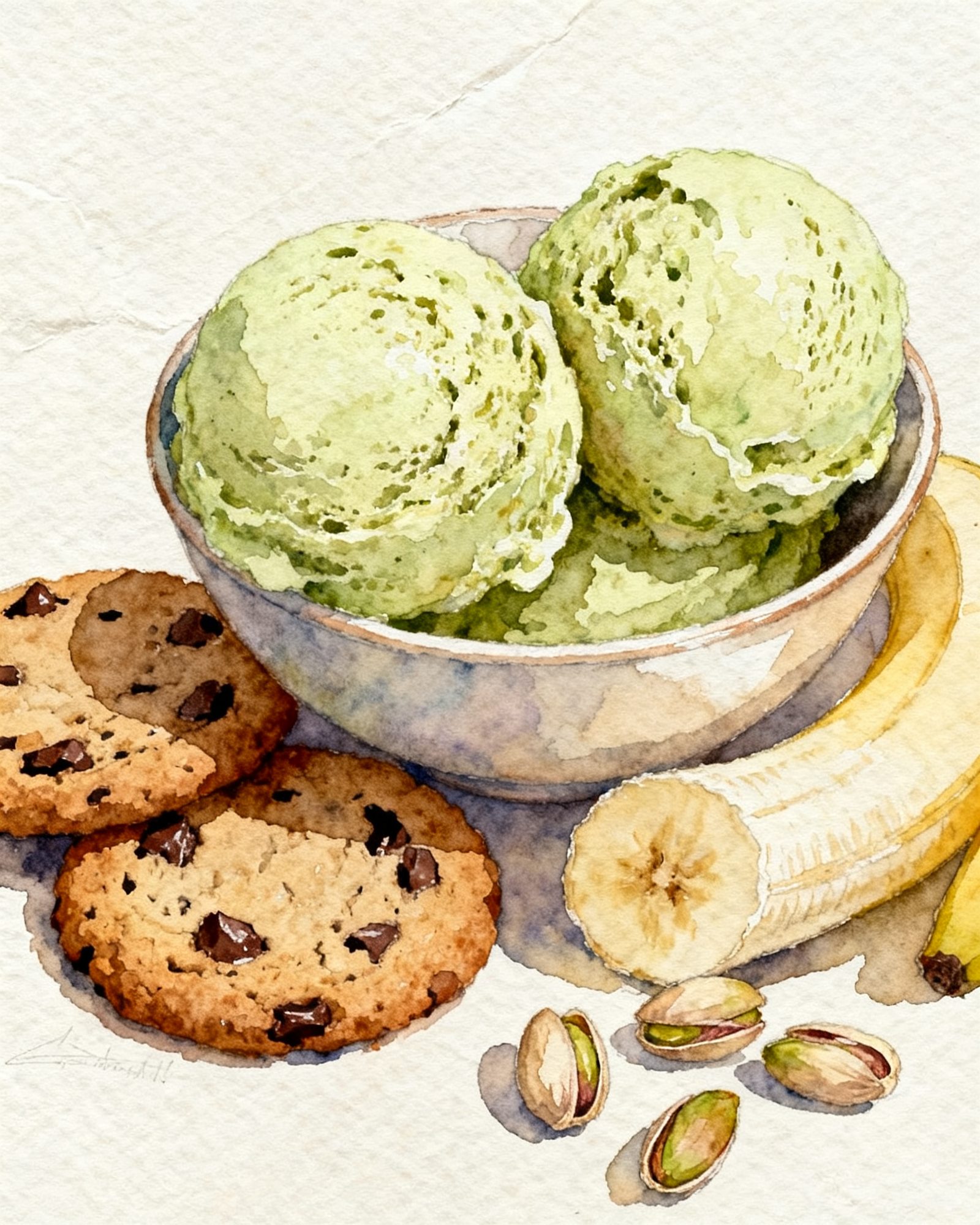
Makes About 2 cups, 3 servings
Ingredients
- 4 medium (about 470 g) ripe bananas, yellow with brown speckles
- 2 tbsp unsweetened soy milk, or another plant milk; you may not need it all
- 1/2 tsp vanilla extract
- 1 pinch fine salt
Equipment
- Baking sheet lined with parchment paper
- Food processor, or a high-speed blender with a tamper
- Rubber spatula
- Freezer bag or airtight container
- Loaf pan or shallow freezer container (for scoopable nice cream)
Method
Peel the bananas and slice them into rounds about 1/2 inch thick.
Spread the slices in a single layer on the lined baking sheet so they do not touch. Freeze until they are hard all the way through, at least 4 hours or overnight. If you are not blending them the same day, move the frozen slices to a freezer bag or airtight container.
Let the frozen slices stand on the counter for 3 to 5 minutes, just until the frost on the surface starts to melt. They will still be hard inside.
Put the slices, vanilla and salt in the food processor (for a high-speed blender, see the next step). Pulse about 10 times to break the bananas into crumbs, then let the machine run, stopping to scrape down the bowl every 30 seconds or so. The bananas go from crumbs to a sticky, pebbly paste and then suddenly turn smooth, pale and glossy, like soft-serve, 3 to 5 minutes in all.
Add the soy milk only if the bananas stay crumbly and the blade spins without catching them after about 2 minutes: add 1 tablespoon, process, and add the second only if needed. In a high-speed blender, pour the milk in first, add the frozen slices and use the tamper to keep them moving into the blades on low to medium speed.
Serve right away as soft-serve. For a firmer, scoopable texture, spread it in a loaf pan or shallow container, cover and freeze for 1 to 2 hours, until a scoop holds its shape.
Nutrition per serving
| Calories | 150 |
|---|---|
| Total fat | 0.5 g |
| Saturated fat | 0 g |
| Carbohydrate | 36 g |
| Fiber | 4 g |
| Total sugars | 19 g |
| Protein | 2 g |
| Sodium | 55 mg |
| Calcium | 20 mg |
| Iron | 0.5 mg |
Per serving, calculated from USDA FoodData Central values for the ingredients and amounts listed. Calories, fat, carbohydrate, fiber, sugars, protein and sodium are rounded with the FDA Nutrition Facts label rules; calcium is shown to the nearest 10 mg and iron to the nearest 0.1 mg. Brands differ, so treat the figures as estimates.
How these numbers were calculated
Each ingredient as weighed for the calculation and the USDA FoodData Central record its nutrients come from. Where USDA has no record for an ingredient (vegan butter, nutritional yeast, coconut sugar), the closest generic record is used and named here.
| Ingredient | Grams | USDA record |
|---|---|---|
| 4 medium (about 470 g) ripe bananas, yellow with brown speckles | 472 g | FDC 173944: Bananas, raw (SR Legacy). Weight from: USDA portion '1 medium (7" to 7-7/8" long)' |
| 2 tbsp unsweetened soy milk, or another plant milk; you may not need it all | 30.4 g | FDC 175215: Soymilk (all flavors), unsweetened, with added calcium, vitamins A and D (SR Legacy). Weight from: USDA portion '1 cup' (1 cup = 16 tbsp = 48 tsp) |
| 1/2 tsp vanilla extract | 2.1 g | FDC 173471: Vanilla extract (SR Legacy). Weight from: USDA portion '1 tsp' |
| 1 pinch fine salt | 0.4 g | FDC 173468: Salt, table (SR Legacy). Weight from: USDA portion '1 dash' |
Banana nice cream is frozen banana blended until it turns into something that looks and eats like soft-serve. It is often called one-ingredient ice cream, and bananas really are the whole base here: the recipe card adds only a little vanilla, a pinch of salt and, if the machine needs it, a spoonful of plant milk. What makes it work is the order of operations. Ripe bananas, sliced before freezing, frozen hard, then processed patiently past the crumbly stage, give a smooth, creamy result without watering it down.
Why frozen bananas turn creamy
Most fruit blended from frozen becomes a slush or a sorbet: juicy fruit is mostly water, and the water freezes into crystals you can feel on your tongue. Bananas are different. They are dense and fleshy rather than juicy, and a ripe banana is high in sugar and contains pectin, so when the frozen fruit is broken up finely it holds together as a thick, smooth purée instead of separating into ice and pulp. That is why frozen banana is also the base of so many dairy-free milkshakes.
The texture changes in stages, and knowing them is most of the technique:
- Crumbs. The first pulses break the slices into something like gravel. It looks as if it will never work.
- Paste. After a minute or two the crumbs clump into a sticky, pebbly mass that rides around the blade.
- Soft-serve. Quite suddenly the mass turns pale, glossy and smooth, and the machine sounds smoother too. Stop here.
Adding milk during the crumb stage is a common mistake. It does help the blade, but every spoonful makes the result softer and closer to a smoothie. Scrape the bowl down instead and give it time.
Ripeness, slicing and freezing
Ripeness decides the flavor. Use bananas that are fully yellow with brown speckles. As bananas ripen, much of their starch turns into sugar, so a speckled banana tastes sweeter and blends creamier, while a banana with green at the tips tastes starchy and slightly chalky once frozen. Very ripe, mostly brown bananas work too and give the sweetest, most banana-forward result.
Slice before freezing. A whole frozen banana is hard to peel and too big for most machines. Rounds about 1/2 inch thick freeze quickly and evenly and break down without straining the motor.
Freeze in a single layer. Slices piled into a bag freeze into one solid lump. Spread them on a parchment-lined baking sheet so they do not touch, freeze them hard, then move them to a bag. A batch of frozen slices kept in the freezer means nice cream is always a few minutes away.
Food processor or blender
A food processor is the easiest tool: its wide bowl and flat blade work frozen fruit without any liquid. A high-speed blender with a tamper also works; put the milk in first and keep pushing the slices into the blades. An ordinary blender usually stalls on frozen slices unless you add more liquid, which gives a softer, drinkable result. Small single-serve blenders struggle most.
Letting the slices sit on the counter for a few minutes before processing, as the card says, takes the hardest edge off and is easier on the machine.
Recipes disagree on this point: some say a food processor only turns banana into flakes, others that a blender cannot do it without milk. Both are describing the same crumb stage. In a processor the flakes are stage one, and they turn smooth if you keep going and scraping; in a blender the fruit only moves if there is liquid or a tamper to push it down. Choose the machine you have and expect the stages either way.
Pint-style ice cream machines
Machines that freeze a pint container solid and then shave it with a spinning blade make nice cream differently. Blend fresh ripe bananas with the vanilla, salt and a splash of plant milk until smooth, pour into the pint container, freeze it level until solid all the way through, usually overnight, and then run the machine’s ice cream setting. If it comes out powdery, add a tablespoon of plant milk and run the re-spin setting. The result is closer to scooped ice cream than to soft-serve.
With no blender or processor
There is no real substitute for a machine with frozen slices: a fork or a potato masher cannot break them down. The nearest option is to mash very ripe fresh bananas with the vanilla and salt until smooth, spread the purée in a shallow container and freeze it, scraping and stirring it with a fork every 30 minutes until it is frozen. It comes out icier and more like a frozen purée than soft-serve, but it still tastes of the same thing.
One banana or a single serving
One frozen banana is too little for most full-size processors, because the blade cannot catch so few slices. Use a mini food processor or a small blender cup, add a tablespoon of plant milk from the start, and stop to scrape often. In a standard processor, two bananas is about the smallest batch that goes through the stages on the card reliably.
Soft-serve or scoopable
Straight from the processor, nice cream is soft-serve: it slumps slowly in the bowl and starts to soften and run within minutes. For neat scoops, spread it in a loaf pan, cover it and freeze it briefly, as in the last step on the card. Leave it much longer and it freezes rock hard, because unlike churned ice cream it has almost no fat and no added sugar to keep it soft. If that happens, let it stand at room temperature until a spoon goes in, or break it into chunks and process it again for a few seconds.
The blue spirulina version
Blue nice cream gets its color from blue spirulina, a blue color extract made from spirulina and sold as a powder. Add it to the bananas at the start of processing: begin with 1/2 teaspoon for this batch and add more, a little at a time, for a deeper color. The pale yellow-cream of the bananas softens and slightly greens the shade, so expect a light aqua blue rather than deep blue. Blue spirulina has very little taste of its own, so the nice cream still tastes of banana and vanilla. It is not part of the nutrition on the card.
A few things to know before swapping:
- Green spirulina is not the same product. It turns nice cream teal-green and adds a distinct seaweed flavor.
- Butterfly pea flower powder also colors food blue, but it turns purple when it meets acid, so do not combine it with lemon or lime.
- Blue spirulina powders vary in strength, so use the color, not the measuring spoon, as your guide.
Other flavors from the same base
Each of these goes in with the bananas unless noted:
- Chocolate: 2 tablespoons of unsweetened cocoa powder and 1 tablespoon of maple syrup. For a richer, churned version, see vegan chocolate ice cream.
- Matcha-lime: 1 to 2 teaspoons of matcha powder and the grated zest of one lime. Matcha is a tea and contains caffeine.
- Strawberry: replace one of the bananas with a cup of frozen strawberries. The result is a little icier, because strawberries are juicier than bananas.
- Peanut butter: 2 tablespoons of smooth peanut butter. It makes the mix stiffer, so process a little longer.
- Mint chip: a few drops of peppermint extract with the bananas; fold in chopped dairy-free dark chocolate after processing.
- Mango, pineapple or peach: replace one of the bananas with a cup of the frozen fruit. Like strawberries, these are juicier than banana, so the result is slightly icier and more sorbet-like.
- Richer, with coconut milk: use 2 tablespoons of canned coconut milk in place of the soy milk. The extra fat gives a creamier, slower-melting soft-serve; it adds coconut.
- Tangy, with plant-based yogurt: process in 1/4 cup of plain unsweetened soy or coconut yogurt once the bananas are smooth. It softens the texture, so freeze briefly afterward if you want scoops.
- With dates: 2 soft pitted dates, chopped, sweeten and add a caramel note. Process them with the bananas from the start so no pieces remain.
- With protein powder: add 1 scoop of vanilla or chocolate plant protein powder and 1 to 2 extra tablespoons of plant milk, since the powder absorbs liquid and makes the mix stiff.
- Cookie dough: fold in crumbled baked cookies instead of raw dough. The FDA says “DO NOT use raw cookie dough in ready-to-eat ice cream,” because flour is a raw ingredient, and egg-free dough is no exception.
Popsicles
Spoon freshly made soft-serve into ice-pop molds, tap them on the counter to settle it, add the sticks and freeze until solid. Nice cream freezes hard, so run the molds under warm water for a few seconds to release them.
Nice cream without bananas
Banana is what makes nice cream creamy without fat, so other fruit alone gives a sorbet rather than soft-serve. Frozen mango is the closest substitute; process it with a few tablespoons of canned coconut milk so it turns creamy rather than icy. The result tastes of mango and coconut, not banana.
Crumbled cookies make a good topping; vegan chocolate chip cookies broken into pieces and scattered over just before serving stay crunchy. For a richer frozen dessert made from a cooked coconut-milk and pistachio base, churned or no-churn, try vegan pistachio ice cream.
Sweetness without added sugar
The sweetness comes from the bananas: the recipe adds no sugar or syrup. The U.S. Food and Drug Administration explains that added sugars on a label “do not include naturally occurring sugars that are found in milk, fruits, and vegetables”, so the sugars on the card come almost entirely from the fruit. Cold dulls sweetness, so frozen desserts taste less sweet than they would at room temperature. If yours tastes flat, the fix is riper bananas next time; for now, a teaspoon of maple syrup works. How maple syrup, dates and other sweeteners compare explains the differences between them.
What goes wrong and how to fix it
- Icy or grainy: the slices picked up frost in the freezer, or too much milk went in. Keep frozen slices airtight and add liquid one tablespoon at a time.
- Stuck at the crumb stage: keep processing and scraping. If the machine is laboring, let the bowl stand for a minute so the fruit softens slightly.
- Runny: the bananas were not frozen solid, or the machine ran so long it warmed the mix. Freeze it in a shallow container until it firms up.
- Gray or brown streaks: the bananas browned before freezing. Slice and freeze them soon after peeling. The color does not change the flavor much.
Storing it
Nice cream is at its best right after blending. Leftovers can go into a covered container in the freezer; FoodSafety.gov notes that freezer storage guidance is “for quality only” and that frozen foods stored continuously at 0°F (-18°C) or below “can be kept indefinitely.” The texture is what suffers: it sets hard and can turn icy, so let it soften or re-blend it before serving. Do not leave melted nice cream out and refreeze it later; the USDA Food Safety and Inspection Service advises throwing away perishable food left at room temperature for more than 2 hours (1 hour if the temperature is over 90°F).
Allergy and ingredient notes
As written, the recipe contains soy, from the small amount of soy milk. Use oat milk or any other plant milk for a soy-free version, or leave the milk out if your machine manages without it. The peanut butter variation contains peanuts, the coconut milk and coconut yogurt versions contain coconut, and chopped nut toppings add tree nuts; check chocolate and cookie toppings for milk, nuts and soy if you are avoiding them.
Common questions
Why is my nice cream crumbly instead of creamy?
It needs more processing, not more liquid. Frozen banana passes through a crumbly stage and a sticky, pebbly stage before it turns smooth, and many people stop or add milk too early. Keep the machine running and scrape the bowl down; add a tablespoon of plant milk only if the blade is spinning without catching the fruit.
Can I make nice cream in a regular blender?
A high-speed blender with a tamper works well because you can push the frozen slices into the blades. An ordinary blender usually needs more liquid to keep moving, which gives a softer, smoothie-like result. A food processor is the easiest tool, because the wide bowl and flat blade break the frozen slices down without any liquid.
How do I make blue nice cream?
Add blue spirulina powder to the bananas before processing, starting with 1/2 teaspoon for this batch and adding more for a deeper color. Blue spirulina is a blue color extract made from spirulina and has very little taste. Green spirulina powder gives a teal-green color and a noticeable seaweed flavor.
Does banana nice cream taste like bananas?
Yes, mildly. Freezing dulls the banana flavor a little, and vanilla and a pinch of salt round it out, but the base always tastes of banana. Strong flavors such as cocoa, peanut butter or frozen berries cover it most.
Can I keep nice cream in the freezer?
Yes, in a covered container, but expect a hard, icy block rather than scoopable ice cream, because it has almost no fat or added sugar. The storing section below explains how to bring it back to a soft texture.
Sources
Read next
Vegan pistachio ice cream
A coconut-milk pistachio ice cream with real pistachio flavor and no green dye: blending the nuts, a chilled base that churns smooth, plus a no-churn method.
Vegan butter pecan ice cream with caramel
Dairy-free butter pecan ice cream: pecans toasted in vegan butter, a brown sugar coconut-milk base and a cold coconut caramel swirl. Churned or no-churn.
Vegan chocolate chip cookies: chewy, golden, no eggs
Chewy vegan chocolate chip cookies made with vegan butter and no eggs: why brown sugar and chilling matter, when to pull them, ice cream sandwiches, freezing.
Chia pudding: the ratio, the method and five flavors
How to make chia pudding that sets thick and smooth: the 1-to-4 ratio of seeds to plant milk, the second stir that stops clumps, flavors and storage.
Maple almond granola with big clusters
Homemade maple almond granola with big crunchy clusters: press it flat, bake at 325°F without stirring, cool it untouched. Plus a chocolate version.