Chia pudding: the ratio, the method and five flavors
How to make chia pudding that sets thick and smooth: the 1-to-4 ratio of seeds to plant milk, the second stir that stops clumps, flavors and storage.
Makes About 2 1/2 cups, 2 servings
Ingredients
- 2 cups (480 ml) unsweetened soy milk, or another plant milk
- 1 1/2 tbsp maple syrup
- 1 tsp vanilla extract
- 1 pinch fine salt
- 1/2 cup (84 g) chia seeds
To serve
- 1/2 cup (62 g) fresh raspberries or other berries (optional)
Equipment
- Mixing bowl or 1-quart jar with a lid
- Whisk or fork
Method
In a mixing bowl or a 1-quart jar, whisk the soy milk, maple syrup, vanilla and salt until the syrup dissolves.
Add the chia seeds and whisk for about 30 seconds, until no clumps remain and the seeds are evenly suspended.
Let the mixture stand for 10 minutes, then whisk again, scraping the bottom and sides. The seeds start to gel in these first minutes, and this second stir is what keeps them from setting in lumps.
Cover and refrigerate for at least 4 hours, or overnight, until thick and spoonable.
Stir before serving. If it is thicker than you like, loosen it with a splash of milk. Spoon into bowls or jars and top with the berries.
Nutrition per serving
| Calories | 330 |
|---|---|
| Total fat | 17 g |
| Saturated fat | 2 g |
| Carbohydrate | 32 g |
| Fiber | 16 g |
| Total sugars | 11 g |
| Protein | 14 g |
| Sodium | 180 mg |
| Calcium | 580 mg |
| Iron | 4.4 mg |
Per serving, calculated from USDA FoodData Central values for the ingredients and amounts listed, leaving out the optional ingredients. Calories, fat, carbohydrate, fiber, sugars, protein and sodium are rounded with the FDA Nutrition Facts label rules; calcium is shown to the nearest 10 mg and iron to the nearest 0.1 mg. Brands differ, so treat the figures as estimates.
How these numbers were calculated
Each ingredient as weighed for the calculation and the USDA FoodData Central record its nutrients come from. Where USDA has no record for an ingredient (vegan butter, nutritional yeast, coconut sugar), the closest generic record is used and named here.
| Ingredient | Grams | USDA record |
|---|---|---|
| 2 cups (480 ml) unsweetened soy milk, or another plant milk | 486 g | FDC 175215: Soymilk (all flavors), unsweetened, with added calcium, vitamins A and D (SR Legacy). Weight from: USDA portion '1 cup' |
| 1 1/2 tbsp maple syrup | 30 g | FDC 169661: Syrups, maple (SR Legacy). Weight from: USDA portion '1 tbsp' |
| 1 tsp vanilla extract | 4.2 g | FDC 173471: Vanilla extract (SR Legacy). Weight from: USDA portion '1 tsp' |
| 1 pinch fine salt | 0.4 g | FDC 173468: Salt, table (SR Legacy). Weight from: USDA portion '1 dash' |
| 1/2 cup (84 g) chia seeds | 84 g | FDC 2707590: Chia seeds (FNDDS 2021-2023). Weight from: USDA portion '1 cup' |
| 1/2 cup (62 g) fresh raspberries or other berries (optional) | not counted (optional) | FDC 167755: Raspberries, raw (SR Legacy). Weight from: USDA portion '1 cup' |
Chia pudding is chia seeds soaked in plant milk until each seed is wrapped in its own gel and the whole bowl turns thick and creamy. It needs no cooking and no blender, and it only goes wrong in two ways: too much or too little liquid, and lumps from seeds that settled before they gelled. The recipe card above uses one part seeds to four parts milk and a second stir ten minutes after mixing, which takes care of both.
Why one part seeds to four parts milk works
Chia seeds swell as they absorb liquid. The American College of Gastroenterology notes that they can take up to 27 times their weight in water, which is why a small amount of seeds sets a large amount of milk. By volume, 1 part seeds to 4 parts milk is the point where the pudding holds a spoon upright but still feels creamy rather than gluey.
You can move either way from there:
- Looser, closer to a breakfast drink: add another 1/4 to 1/2 cup of milk to the recipe.
- Firm enough to layer in a jar or unmold: cut the milk back by about 1/4 cup.
- Single serving: 2 tablespoons of seeds to 1/2 cup of milk, mixed directly in a jar.
The ratio is by volume, so measure the seeds level in a dry measuring cup and the milk in a liquid measuring cup. If you weigh instead, the card’s 1/2 cup of seeds is 84 g.
Scaling the ratio
| Batch | Chia seeds | Plant milk | Maple syrup | Container |
|---|---|---|---|---|
| Small jar (half a card serving) | 2 tbsp | 1/2 cup | about 1 tsp | 8-ounce jar |
| One card serving | 1/4 cup | 1 cup | 2 1/4 tsp | 12- to 16-ounce jar |
| The card (2 servings) | 1/2 cup | 2 cups | 1 1/2 tbsp | 1-quart jar or bowl |
| Four servings | 1 cup | 4 cups | 3 tbsp | large bowl, then portion |
Keep the vanilla and salt in proportion too: 1/2 teaspoon of vanilla per cup of milk, and a pinch of salt for every two cups. Leave a little headspace in each jar, because the seeds swell and the pudding needs room to be stirred.
What it should look like
Set chia pudding looks like tapioca pudding: every seed sits in its own clear halo of gel, spread evenly through the milk, with no layer of liquid on top or seeds packed at the bottom. Tip the jar and it should move slowly as one mass. Black and white chia seeds behave the same way; white seeds simply give a paler pudding, which matters only if you are layering colors.
The second stir is the whole technique
When chia seeds first meet liquid they float, then sink, and within a few minutes the outside of each seed turns slippery and sticky. Seeds that are touching at that moment glue together into clumps that stay firm and uneven if they are left alone. Whisking once when you add the seeds, then again after about 10 minutes, separates them while the gel is forming. Scrape the bottom of the bowl or jar on the second stir, because that is where the clumps collect.
If you forget and find lumps the next morning, whisk hard for a minute; most will break up.
Blended chia pudding
Some people dislike the seedy, tapioca-like texture. For a completely smooth, mousse-like pudding, blend the finished pudding for 20 to 30 seconds in a blender, or blend the milk, syrup, vanilla, salt and seeds together first and then chill. Blending before chilling gives a looser set, so chill it overnight; blending after chilling gives the thickest, most mousse-like result.
Choosing the milk
Any plant milk sets the seeds, but they taste and feel different:
- Soy milk (used on the card) is neutral and creamy. The fortified soy milk on the card also supplies about half of the calcium shown there.
- Oat milk is slightly sweet and gives a soft, rounded pudding.
- Almond milk is thinner and lighter; use a little less of it or expect a looser set.
- Canned coconut milk is too rich on its own for most people, but half coconut milk and half another milk makes a dessert-style pudding.
Whatever you use, unsweetened milk lets you control the sweetness with the maple syrup. For how the common plant milks compare on protein, calcium and sugars, see the plant milk comparison.
With plant-based yogurt
For a thicker, tangier pudding, replace up to 1/2 cup of the milk with plain unsweetened soy or coconut yogurt and keep the seeds the same. Whisk the yogurt into the milk before the seeds go in so there are no streaks. Yogurt makes the set firmer, so loosen it with milk in the morning if needed; homemade coconut yogurt works as well as a store-bought one.
With protein powder
Plant protein powder absorbs liquid too. Whisk it into the milk first, before the seeds, and add an extra 1/4 cup of milk per scoop so the pudding does not set stiff and chalky. Unflavored or vanilla powders work best; some are already sweetened, so taste before adding all the maple syrup.
With water, juice or a ready-made drink
Water sets the seeds just as well as milk but tastes thin; juice gives a sweet, fruity jelly rather than a creamy pudding. A ready-to-drink plant protein shake or chocolate plant milk can replace the milk one for one, but leave out the maple syrup until you have tasted it, because most are already sweetened.
How long it takes to set, and eating it sooner or warm
Give the pudding the 4 hours on the card, or overnight, which is when the seeds are fully soft and the texture is even. It can be eaten sooner: about 15 to 20 minutes after mixing it is thick enough to spoon, but the seeds still have some bite and the liquid around them is thinner. If that is the plan, use slightly less milk so it reaches a spoonable texture faster.
Chia pudding does not have to be cold. To eat it warm, heat a portion gently in a small saucepan over low heat, or in the microwave in short bursts, stirring each time, until it is warm through. It thickens as it warms, so stir in a splash of milk. Warm it only as much as you plan to eat.
Five flavors from the same base
Make the base on the card and change one or two things:
- Vanilla-berry: the recipe as written, topped with fresh or thawed frozen berries.
- Chocolate: whisk 2 tablespoons of unsweetened cocoa powder into the milk before adding the seeds, and add an extra 1/2 tablespoon of maple syrup. Cocoa clumps in cold milk, so whisk it with the syrup into a paste first.
- Mango-coconut: use half canned coconut milk, half soy milk; top with diced mango and a squeeze of lime.
- Cinnamon-apple: add 1/2 teaspoon of ground cinnamon to the milk; top with grated apple and chopped walnuts.
- Peanut butter and banana: whisk 2 tablespoons of peanut butter into the milk until smooth; top with sliced banana.
Toppings change the nutrition on the card, which counts only the pudding base. Crunchy toppings such as maple almond granola go on at the last minute so they stay crisp.
Chia pudding or overnight oats?
Both are no-cook breakfasts mixed the night before, and they are often confused. The difference is what does the thickening:
| Chia pudding | Overnight oats | |
|---|---|---|
| What thickens it | Chia seeds forming gel | Rolled oats softening in milk |
| Texture | Smooth gel around soft seeds, like tapioca | Soft, chewy oats, like cold porridge |
| Ratio | 1 part seeds to 4 parts milk | About 1 part oats to 1 1/2 parts milk |
| Minimum soak | The card’s 4 hours; spoonable sooner | Overnight |
| Gluten | Made with gluten-free ingredients; check labels for cross-contact | Needs certified gluten-free oats for celiac disease |
If you prefer a chewier breakfast, choose oats; for a spoonable pudding, choose chia. They also combine well: the overnight oats recipe already stirs in 2 tablespoons of chia seeds to thicken the oats.
Eat chia seeds soaked, not dry
Because chia seeds absorb so much liquid, the American College of Gastroenterology advises that they should never be eaten dry, and that people with a history of swallowing problems or esophageal narrowing should eat them only once they have fully expanded in liquid. In chia pudding the seeds are soaked by design, which is one more reason to give it the full chilling time. For what the seeds themselves contain, including their omega-3 fat, see chia seed nutrition.
What goes wrong and how to fix it
- Thin and watery after a night in the fridge: the seeds were under-measured or the milk over-poured. Stir in another tablespoon or two of seeds, wait 10 minutes, stir again and chill for a few more hours so the new seeds soften too.
- Thick and gluey: too many seeds for the milk. Loosen with milk a few tablespoons at a time.
- Crunchy seeds: not enough soaking time. Give it the full 4 hours; at 20 minutes the seeds are only partly hydrated.
- Bland: chia seeds taste of almost nothing, so the flavor comes entirely from the milk, sweetener, vanilla and salt. The pinch of salt matters more than it looks.
Making it ahead and storing it
Chia pudding is a natural make-ahead breakfast: a batch mixed in individual jars on Sunday evening covers breakfast through Wednesday. Keep the jars covered in the refrigerator at 40°F or below and eat them within 3 to 4 days, the limit the USDA Food Safety and Inspection Service gives for refrigerated leftovers; for a full week, mix a second batch midweek. Add fresh fruit on the morning you eat it, because cut fruit weeps juice into the pudding as it sits. Many recipes promise longer; for homemade pudding, the 3-to-4-day limit is the one with a food-safety source behind it.
Freezing chia pudding
Chia pudding freezes. Portion it into freezer-safe jars or containers, leave some headspace for expansion, and freeze. The USDA Food Safety and Inspection Service says leftovers can be frozen for 3 to 4 months; frozen food stays safe longer, but FoodSafety.gov notes that freezer times are for quality only. Thaw a jar overnight in the refrigerator and eat it within 3 to 4 days, the FSIS window for food thawed that way. The pudding can look slightly weepy after thawing; a hard whisk brings it back together. Freeze it without fruit toppings, which turn soft and watery.
Allergy and ingredient notes
The recipe as written contains soy (from the soy milk). Swap in oat or coconut-based milk for a soy-free version. The variations add other allergens: peanuts in the peanut butter version, tree nuts in the walnut topping and in a granola topping (almonds), and coconut in the mango-coconut version. Chia seeds are seeds, not nuts, but check the packaging if you need to avoid foods processed alongside tree nuts or sesame. The base recipe is made with gluten-free ingredients; check labels for cross-contact, and note that a granola topping usually contains oats, which need to be certified gluten-free for anyone with celiac disease. Maple syrup can be replaced with the same amount of another liquid sweetener; the guide to natural sweeteners explains how they differ.
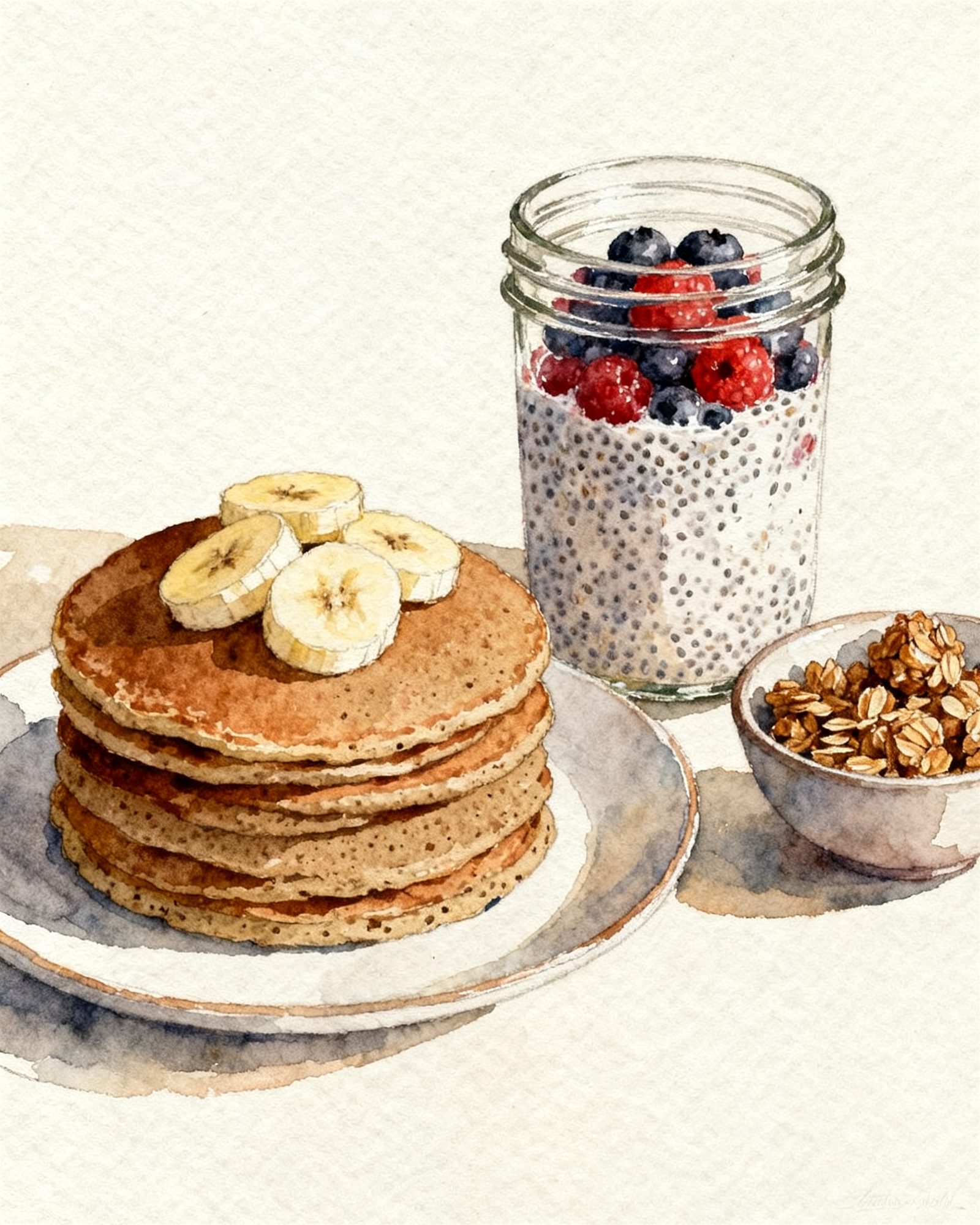
If you are looking for a warm breakfast instead, vegan buckwheat pancakes use the same soy milk and maple syrup, and a batch freezes well for quick weekday mornings.
Common questions
What is the right ratio for chia pudding?
One part chia seeds to four parts liquid by volume gives a thick, spoonable pudding: 1/2 cup seeds to 2 cups plant milk, or 2 tablespoons to 1/2 cup for a single small jar. Use a little more milk for a looser, drinkable texture and a little less for a pudding that holds its shape.
Why is my chia pudding lumpy?
The seeds were not stirred again after they started to gel. Chia seeds form a coating of gel within minutes of meeting liquid and stick together if they settle. Whisk again about 10 minutes after mixing, scraping the bottom, and the pudding sets evenly.
How long does chia pudding need to set?
At least 4 hours in the refrigerator, and overnight is easiest. After 15 to 20 minutes it is already thick enough to eat, but the texture is looser and the seeds are still slightly crunchy.
Can I use water or juice instead of plant milk?
Water sets the seeds just as well but gives a thin-tasting pudding. Plant milks give body and creaminess: soy milk is the most neutral, oat milk is slightly sweet, and canned coconut milk mixed half and half with another milk gives the richest result.
How long does chia pudding keep in the fridge?
Up to 3 to 4 days, covered, in a refrigerator at 40°F or below, which is the limit the USDA Food Safety and Inspection Service gives for refrigerated leftovers. It thickens a little more each day, so stir in a splash of milk before eating.
Can you freeze chia pudding?
Yes. Freeze it in portions without fruit toppings and thaw it overnight in the refrigerator. The USDA Food Safety and Inspection Service gives 3 to 4 months for frozen leftovers, a quality limit rather than a safety one. Whisk it well after thawing, because it can look slightly watery.
Sources
Read next
Vegan buckwheat pancakes, light and fluffy
Fluffy vegan buckwheat pancakes with no eggs or dairy: how the batter rises, why it rests 10 minutes, when to flip, a banana option, and freezing tips.
Maple almond granola with big clusters
Homemade maple almond granola with big crunchy clusters: press it flat, bake at 325°F without stirring, cool it untouched. Plus a chocolate version.
What is nutritional yeast and how to use it
Nutritional yeast explained: what the flakes are, fortified vs unfortified, how much vitamin B12 the NIH lists, the niacin caution, and how to cook with it.
Natural sweeteners compared: maple, dates, coconut sugar
What maple syrup, agave, coconut sugar, dates, molasses and stevia are, how the FDA and Dietary Guidelines treat them, and how each one behaves in baking.
Vegan bean chili: thick, smoky and made with three beans
A thick vegan chili with kidney, black and pinto beans: blooming the spices, what thickens it, canned vs. dried beans done safely, toppings and freezing.