Vegan buckwheat pancakes, light and fluffy
Fluffy vegan buckwheat pancakes with no eggs or dairy: how the batter rises, why it rests 10 minutes, when to flip, a banana option, and freezing tips.
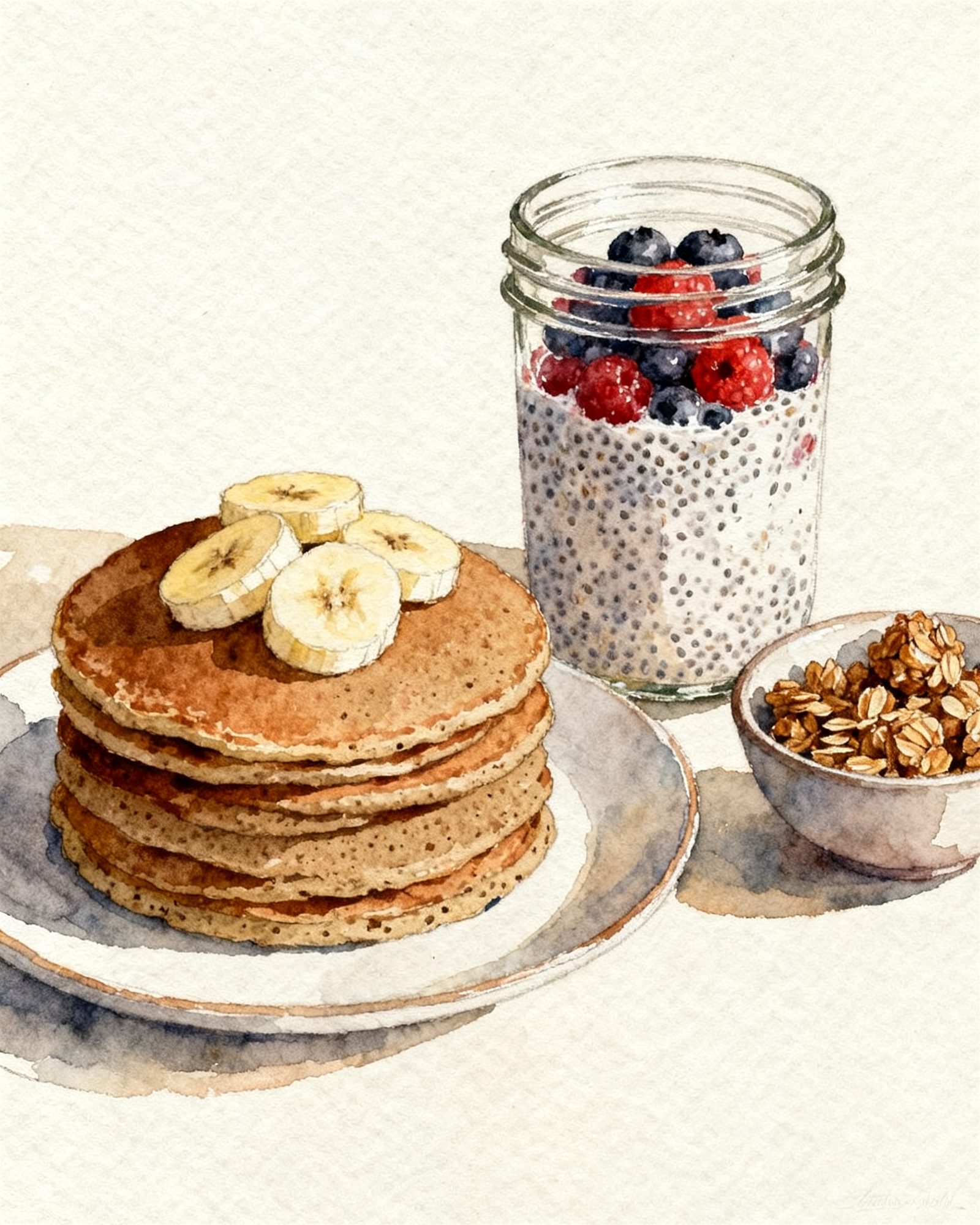
Makes About 12 pancakes (4 inches across), 4 servings
Ingredients
- 1 3/4 cups (420 ml) unsweetened soy milk, or another plant milk, plus up to 2 tbsp more if needed
- 1 tbsp apple cider vinegar
- 2 tbsp ground flaxseed
- 1 tbsp maple syrup
- 2 tbsp canola oil, or another neutral oil
- 1 tsp vanilla extract
- 1 1/2 cups (180 g) buckwheat flour, spooned into the cup and leveled
- 1 tbsp baking powder
- 1/4 tsp baking soda
- 1/4 tsp fine salt
- 1 tsp canola oil, for the skillet
To serve
- 1/4 cup (79 g) maple syrup, for serving (optional)
- 1 medium (about 120 g) ripe banana, sliced (optional)
Equipment
- Large mixing bowl
- Medium bowl
- Whisk
- 1/4-cup measure
- Large nonstick skillet or griddle
- Thin, wide spatula
- Baking sheet (to keep pancakes warm)
Method
Heat the oven to 200°F (95°C) and put a baking sheet on the center rack, for keeping the cooked pancakes warm. In a large mixing bowl, whisk the soy milk and cider vinegar together and let stand for 5 minutes. The milk thickens slightly and may look a little curdled, which is expected.
Whisk the ground flaxseed, 1 tablespoon maple syrup, 2 tablespoons canola oil and the vanilla into the milk mixture.
In a medium bowl, whisk the buckwheat flour, baking powder, baking soda and salt until evenly combined, with no lumps of baking soda.
Add the dry ingredients to the wet ingredients and stir with the whisk just until no dry flour remains. The batter looks loose and thin at this point.
Let the batter rest for 10 minutes. It thickens as the flaxseed and buckwheat absorb the liquid, and small bubbles rise to the surface. It is ready when it is thick but still pourable and slowly levels itself from a spoon; if it is too stiff to spread, stir in soy milk 1 tablespoon at a time, up to 2 tablespoons. Do not stir it hard after the rest, or the bubbles are knocked out.
While the batter rests, heat a large nonstick skillet or griddle over medium heat for about 3 minutes (set an electric griddle to 375°F (190°C)). Brush it lightly with some of the 1 teaspoon canola oil. The pan is ready when a drop of water sizzles and evaporates almost at once.
Pour a scant 1/4 cup of batter for each pancake, leaving space between them, and nudge each one with the back of the measure to about 4 inches across. Cook until bubbles cover the surface, the edges look dry and matte, and the underside is deep golden brown, 2 to 3 minutes.
Flip each pancake once with a thin spatula and cook until the second side is browned and the center springs back when lightly touched, 1 1/2 to 2 minutes more. Do not press the pancakes down with the spatula.
Repeat with the remaining batter, brushing the pan with a little more of the oil between batches. If the pancakes brown before bubbles form on top, lower the heat slightly. Keep the cooked pancakes warm in a single layer on the baking sheet in the oven while you cook the rest.
Serve warm with maple syrup and sliced banana.
Nutrition per serving
| Calories | 290 |
|---|---|
| Total fat | 13 g |
| Saturated fat | 1.5 g |
| Carbohydrate | 39 g |
| Fiber | 6 g |
| Total sugars | 5 g |
| Protein | 9 g |
| Sodium | 640 mg |
| Calcium | 370 mg |
| Iron | 2.9 mg |
Per serving, calculated from USDA FoodData Central values for the ingredients and amounts listed, leaving out the optional ingredients. Calories, fat, carbohydrate, fiber, sugars, protein and sodium are rounded with the FDA Nutrition Facts label rules; calcium is shown to the nearest 10 mg and iron to the nearest 0.1 mg. Brands differ, so treat the figures as estimates.
How these numbers were calculated
Each ingredient as weighed for the calculation and the USDA FoodData Central record its nutrients come from. Where USDA has no record for an ingredient (vegan butter, nutritional yeast, coconut sugar), the closest generic record is used and named here.
| Ingredient | Grams | USDA record |
|---|---|---|
| 1 3/4 cups (420 ml) unsweetened soy milk, or another plant milk, plus up to 2 tbsp more if needed | 425.2 g | FDC 175215: Soymilk (all flavors), unsweetened, with added calcium, vitamins A and D (SR Legacy). Weight from: USDA portion '1 cup' |
| 1 tbsp apple cider vinegar | 14.9 g | FDC 173469: Vinegar, cider (SR Legacy). Weight from: USDA portion '1 tbsp' |
| 2 tbsp ground flaxseed | 14 g | FDC 169414: Seeds, flaxseed (SR Legacy). Weight from: USDA portion '1 tbsp, ground' |
| 1 tbsp maple syrup | 20 g | FDC 169661: Syrups, maple (SR Legacy). Weight from: USDA portion '1 tbsp' |
| 2 tbsp canola oil, or another neutral oil | 28 g | FDC 172336: Oil, canola (SR Legacy). Weight from: USDA portion '1 tbsp' |
| 1 tsp vanilla extract | 4.2 g | FDC 173471: Vanilla extract (SR Legacy). Weight from: USDA portion '1 tsp' |
| 1 1/2 cups (180 g) buckwheat flour, spooned into the cup and leveled | 180 g | FDC 170687: Buckwheat flour, whole-groat (SR Legacy). Weight from: USDA portion '1 cup' |
| 1 tbsp baking powder | 13.8 g | FDC 172803: Leavening agents, baking powder, double-acting, sodium aluminum sulfate (SR Legacy). Weight from: USDA portion '1 tsp' (1 cup = 16 tbsp = 48 tsp) |
| 1/4 tsp baking soda | 1.1 g | FDC 175040: Leavening agents, baking soda (SR Legacy). Weight from: USDA portion '1 tsp' |
| 1/4 tsp fine salt | 1.5 g | FDC 173468: Salt, table (SR Legacy). Weight from: USDA portion '1 tsp' |
| 1 tsp canola oil, for the skillet | 4.5 g | FDC 172336: Oil, canola (SR Legacy). Weight from: USDA portion '1 tsp' |
| 1/4 cup (79 g) maple syrup, for serving (optional) | not counted (optional) | FDC 169661: Syrups, maple (SR Legacy). Weight from: USDA portion '1 cup' |
| 1 medium (about 120 g) ripe banana, sliced (optional) | not counted (optional) | FDC 173944: Bananas, raw (SR Legacy). Weight from: USDA portion '1 medium (7" to 7-7/8" long)' |
Buckwheat pancakes have a deeper, nuttier flavor than ordinary pancakes and a soft, slightly earthy crumb that takes maple syrup well. Made with buckwheat flour alone and no eggs or dairy, they can easily turn out dense or gummy, because there is no gluten and no egg to hold the air in. This version fixes that with three things working together: soy milk curdled with vinegar, a double dose of leavening, and ground flaxseed that turns the batter thick enough to trap the bubbles during a 10-minute rest.
Buckwheat is a seed, not a wheat
The name misleads a lot of people. Harvard Health Publishing puts it plainly: “Despite its name, buckwheat is not a type of wheat. Officially, it’s not even a grain but rather a seed that’s harvested from a flowering plant related to rhubarb.” The National Institute of Diabetes and Digestive and Kidney Diseases (NIDDK) includes buckwheat in its list of flours made from gluten-free foods that people with celiac disease can eat.
That makes these pancakes made with gluten-free ingredients; check labels for cross-contact. The NIDDK notes that cross-contact with gluten “can occur at any time, including when foods are grown, processed, stored, prepared, or served.” Buckwheat flour can be milled or packed on equipment shared with wheat, and baking powder contains a starch, so anyone with celiac disease should buy a buckwheat flour and a baking powder labeled gluten-free.
Buckwheat flour ranges from light to dark, and the darker it is, the stronger it tastes. If you find it too strong, the recipe also works with half buckwheat flour and half all-purpose flour (the batter may need a splash less milk), but the pancakes then contain wheat.
How the batter rises without eggs
Eggs give ordinary pancakes both structure and some of their lift. Here those jobs are split up:
- Curdled soy milk. Vinegar thickens the soy milk slightly and makes it acidic, much like buttermilk. The acid reacts with the baking soda the moment the wet and dry ingredients meet, which is the first burst of bubbles.
- Double-acting baking powder. It releases some gas when it gets wet and the rest when it meets the heat of the pan, so the pancakes keep rising as they cook.
- Ground flaxseed. Ground flax forms a thick gel in liquid. That gel binds the batter in place of an egg and gives it enough body to hold the bubbles instead of letting them escape. For other ways to replace eggs and what each one does, see egg substitutes for vegan cooking.
Whole flaxseeds will not work: they stay whole in the batter and form almost no gel. Buy flaxseed already ground, or grind whole seeds in a spice grinder.
Why the batter rests for 10 minutes
Straight after mixing, the batter looks thin and runny, and it is tempting to add more flour. Don’t. Buckwheat flour absorbs liquid slowly, and the flax gel takes a few minutes to form. Over the 10-minute rest the batter thickens to the right consistency on its own, and you can see small bubbles rising to the surface.
The right texture is thick but pourable: a spoonful should slowly level itself out rather than holding a peak. If it stays stiff after resting, the flour was probably packed into the cup; stir in a tablespoon or two of soy milk. Mix gently after the rest, because hard stirring knocks out the bubbles you just waited for.
The rest should not run much longer than that. The baking soda has already started reacting with the vinegar, and batter left for an hour cooks up flatter.
Heat, bubbles and the flip
Medium heat is the setting that matters most. Buckwheat browns quickly, and on a pan that is too hot the outside darkens before the middle sets, which leaves a gummy center. Preheat the skillet for about 3 minutes; when a drop of water sizzles and evaporates almost at once, it is ready.
Watch the top of the pancake, not the clock:
| What you see | What it means |
|---|---|
| Bubbles form and pop across the whole surface, edges look dry and matte | Ready to flip |
| Bubbles only around the edge, wet and shiny center | Wait longer |
| Underside dark before any bubbles appear | Pan too hot; lower the heat |
| Center springs back when lightly touched after flipping | Done |
Flip once, with a thin, wide spatula slid fully under the pancake. Never press it flat afterward: that squeezes out the air and gives you a heavy, rubbery pancake. The first one is often paler or uneven while the pan settles; adjust the heat for the next batch.
A banana instead of flax
If you have no flaxseed, a ripe banana does the same binding job. Mash 1 medium banana until smooth, whisk it into the curdled soy milk in place of the ground flaxseed, and leave out the tablespoon of maple syrup in the batter, since the banana sweetens it. The pancakes come out somewhat denser, moister and sweeter, with a clear banana flavor. Banana sugars brown faster, so turn the heat down a notch. The nutrition on the card is for the flax version.
Swaps that work and ones that do not
- Plant milk. Oat milk and almond milk both work. They curdle less than soy milk, so the batter is a little thinner; hold back 2 tablespoons of milk and add it only if needed. If you need the pancakes free of gluten, choose an oat milk labeled gluten-free.
- Oil. Any neutral oil works, as does melted coconut oil, which may firm up into small flecks if the milk is cold. Melted vegan butter (a plant-based stick) adds a richer flavor.
- Sweetener. Maple syrup can be replaced with the same amount of agave syrup or another liquid sweetener; natural sweeteners compared explains how they differ.
- Vinegar. Lemon juice curdles the milk in the same way.
- Almond version. Use unsweetened almond milk (holding back 2 tablespoons as above), add 1/4 teaspoon of almond extract with the vanilla, and scatter toasted sliced almonds over the stack. The pancakes then contain tree nuts.
- Flour. Almond flour or coconut flour cannot replace buckwheat flour one for one: they behave completely differently with liquid and the pancakes fall apart. For a wheat-based pancake made with all-purpose flour, use the batter in classic vegan pancakes, which is balanced for it.
Blueberry, pumpkin and other variations
Each of these changes only one or two things in the card’s batter:
| Variation | What to change | What to expect |
|---|---|---|
| Blueberry | Scatter 3/4 cup blueberries over the pancakes right after pouring, a few per pancake; use frozen berries straight from the freezer | Stirring berries into the batter turns it purple-gray; scattering keeps the color clean |
| Pumpkin spice | Replace 1/2 cup of the soy milk with 1/2 cup canned pumpkin purée and add 1 teaspoon pumpkin pie spice to the dry ingredients | Thicker batter and moister, denser pancakes; cook a notch lower so the centers set |
| Buckwheat-oat | Replace 1/2 cup of the buckwheat flour with 1/2 cup oat flour | Milder flavor and a softer crumb; for celiac disease, the oats must be certified gluten-free |
| Higher protein | Replace 1/4 cup of the buckwheat flour with unflavored or vanilla plant protein powder, and add 2 tablespoons more soy milk | Slightly drier and firmer; some powders brown fast, so watch the heat |
| No oil | Leave the 2 tablespoons of oil out of the batter and cook in a good nonstick pan without oil | Firmer, less tender pancakes that stick more easily; flip with care |
| Savory | Leave out the maple syrup and vanilla, add 1/4 teaspoon more salt, black pepper and 2 thinly sliced green onions | Good with tofu scramble or sautéed mushrooms |
Two things that look similar are really different recipes. French buckwheat crepes (galettes) are a thin, unleavened batter cooked very thin, so thinning this batter will not make them; the baking powder makes them puff. And whole buckwheat groats cannot replace the flour: groat pancakes are made by soaking the groats and blending them into a batter, which needs its own amounts.
A half batch and a make-ahead dry mix
Half batch (about 6 pancakes, enough for two): 3/4 cup plus 2 tablespoons soy milk, 1 1/2 teaspoons cider vinegar, 1 tablespoon ground flaxseed, 1 1/2 teaspoons maple syrup, 1 tablespoon oil, 1/2 teaspoon vanilla, 3/4 cup buckwheat flour, 1 1/2 teaspoons baking powder, and 1/8 teaspoon each of baking soda and salt. The method and rest are the same.
Dry mix: for each batch, put 1 1/2 cups buckwheat flour, 2 tablespoons ground flaxseed, 1 tablespoon baking powder and 1/4 teaspoon each of baking soda and salt in a jar, and keep it airtight in the refrigerator, because ground flax goes stale at room temperature. To cook, whisk 1 3/4 cups soy milk with 1 tablespoon vinegar and let it stand for 5 minutes, whisk in the maple syrup, oil and vanilla, add the jar’s contents, stir until just combined and rest the batter 10 minutes. This is the safe way to prepare ahead, since fully mixed batter loses its lift overnight.
Keeping, freezing and reheating
Buckwheat pancakes freeze well, so a full batch is worth cooking even for two people. Let the extras cool in a single layer on a rack, then refrigerate or freeze them within 2 hours of cooking, the limit the USDA Food Safety and Inspection Service (FSIS) sets for leftovers. In the refrigerator at 40°F or below they keep 3 to 4 days.
To freeze, lay them flat on a tray until firm, then stack them in a freezer bag with a square of parchment between layers so they come apart easily. FSIS notes that frozen leftovers are safe indefinitely but lose moisture and flavor over time and gives 3 to 4 months for frozen leftovers. Reheat straight from frozen in a toaster or microwave until hot all the way through; FSIS advises that reheated leftovers reach 165°F.
Mistakes that ruin buckwheat pancakes
- Adding flour to the thin batter before it rests. The batter turns into paste after resting. Wait the 10 minutes first, then adjust.
- Cooking on high heat. The outside burns and the inside stays wet. Medium heat, and patience.
- Flipping too early. A pancake flipped before the bubbles cover the surface tears and collapses. Wait for dry, matte edges.
- Pressing with the spatula. It flattens the pancake and makes it gummy.
- Measuring flour by scooping. Scooping packs the flour and makes a stiff batter. Spoon the flour into the cup and level it.
Allergy notes
As written, the recipe contains soy (in the soy milk). Use oat milk or a coconut-based milk for a soy-free version, or almond milk if tree nuts are not a concern. It contains no wheat ingredients, no peanuts and no tree nuts unless you make the almond version.
For a breakfast you can make the night before with no stove at all, chia pudding uses the same plant milk and maple syrup, and a spoonful of maple almond granola on top of the pancakes adds crunch.
Common questions
Are buckwheat pancakes gluten-free?
Buckwheat is not a type of wheat, and Harvard Health Publishing describes it as gluten-free. These pancakes are made with gluten-free ingredients; check labels for cross-contact, because buckwheat flour and baking powder can be milled or packed alongside wheat. If you have celiac disease, look for products labeled gluten-free.
Why are my buckwheat pancakes gummy in the middle?
Usually the heat was too high, so the outside browned before the center cooked, or the batter was too thick to spread. Cook over medium heat, spread each pancake to about 4 inches, and wait until bubbles cover the surface before flipping. Pressing the pancakes with the spatula also squeezes out the air and makes them dense.
Can I make buckwheat pancake batter the night before?
It is better not to. The baking soda starts reacting with the vinegar as soon as the batter is mixed, so batter that sits overnight cooks up flat. Measure the dry ingredients into one bowl and the wet ingredients into a covered container in the fridge the night before, then combine them in the morning and rest the batter for 10 minutes.
Can I use a banana instead of flaxseed?
Yes, 1 mashed medium ripe banana binds the batter in place of the 2 tablespoons of ground flaxseed. Expect pancakes that are a little denser and sweeter, with a clear banana flavor; the section on the banana swap below gives the details.
How do I freeze and reheat buckwheat pancakes?
Freeze them flat on a tray first, then bag them, so they do not freeze into one block. A toaster reheats them straight from frozen and keeps the outside crisp; a microwave is faster but makes them softer. Either way, heat them until hot all the way through.
Sources
Read next
Chia pudding: the ratio, the method and five flavors
How to make chia pudding that sets thick and smooth: the 1-to-4 ratio of seeds to plant milk, the second stir that stops clumps, flavors and storage.
Maple almond granola with big clusters
Homemade maple almond granola with big crunchy clusters: press it flat, bake at 325°F without stirring, cool it untouched. Plus a chocolate version.
What is nutritional yeast and how to use it
Nutritional yeast explained: what the flakes are, fortified vs unfortified, how much vitamin B12 the NIH lists, the niacin caution, and how to cook with it.
Natural sweeteners compared: maple, dates, coconut sugar
What maple syrup, agave, coconut sugar, dates, molasses and stevia are, how the FDA and Dietary Guidelines treat them, and how each one behaves in baking.
How to make cauliflower rice that is fluffy, not mushy
How to make cauliflower rice with a box grater or food processor, cook it dry in a skillet or roast it, season it, freeze it and avoid mushy, watery rice.