Stuffed peppers with cauliflower rice and black beans
Vegan stuffed peppers with a spiced filling of cauliflower rice, black beans, corn and tomato: par-baked halves, a filling that stays dry, make-ahead tips.
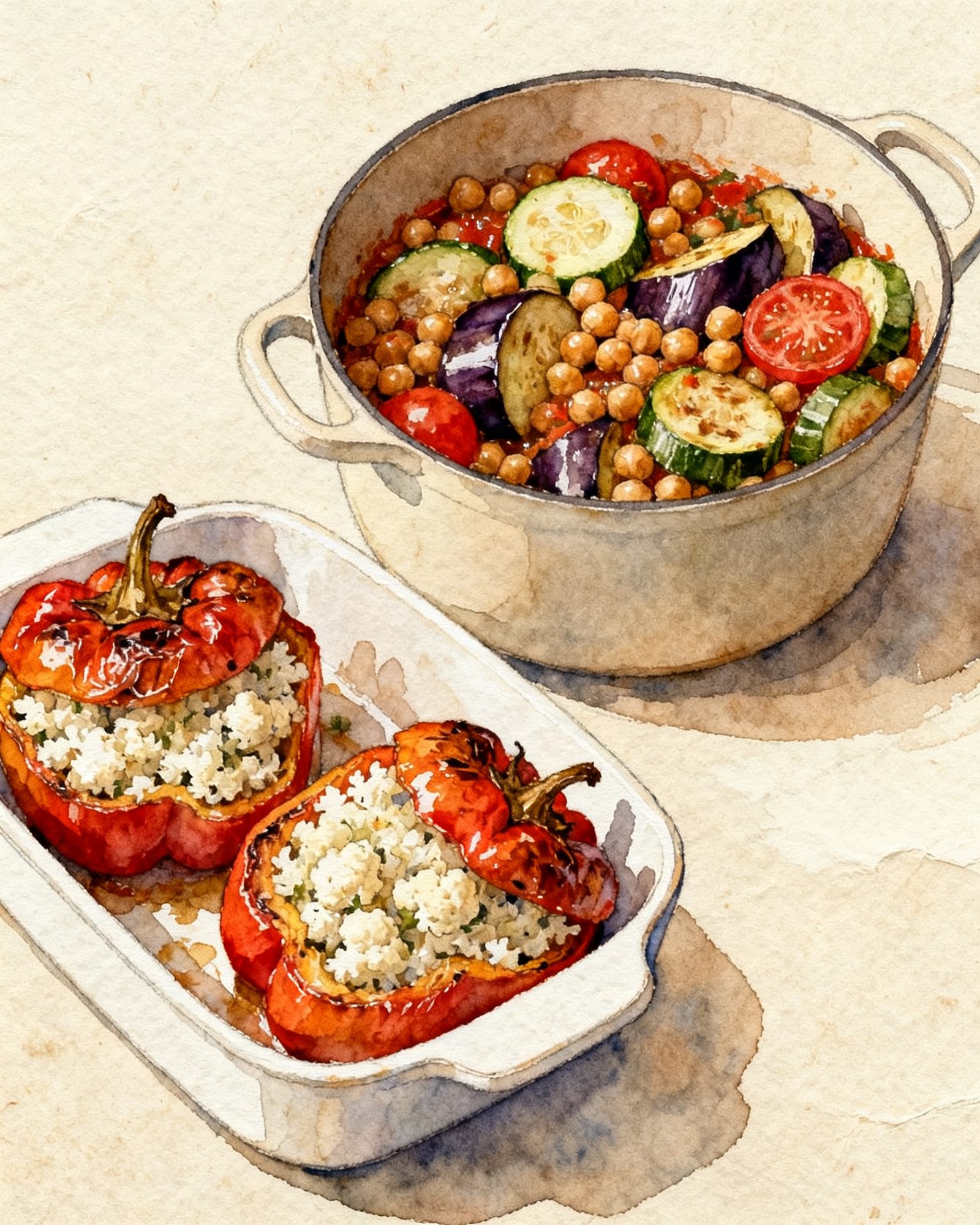
Makes 8 stuffed pepper halves, 4 servings
Ingredients
- 4 large (about 655 g) bell peppers (red, yellow or orange), halved lengthwise through the stem, seeds and ribs removed
- 2 tbsp olive oil, divided
- 3/4 tsp fine salt, divided, plus more to taste
- 1 medium (about 110 g) yellow onion, diced
- 3 cloves (about 9 g) garlic, minced
- 1 1/2 tsp ground cumin
- 1 tsp chili powder
- 1 tsp smoked or sweet paprika
- 1/2 tsp dried oregano
- 1 lb (455 g) cauliflower rice, homemade or frozen (about 4 cups)
- 1/4 tsp ground black pepper
- 1 3/4 cups (315 g) canned black beans, drained and rinsed (one 15-ounce can)
- 5 oz (140 g) frozen corn kernels, about 1 cup, no need to thaw
- 1 cup (240 g) canned diced tomatoes, well drained, from one 14.5-ounce can
- 1 tbsp lime juice
To serve
- 1 cup (150 g) diced ripe avocado (optional)
- 1/2 cup (130 g) tomato salsa (optional)
Equipment
- 9x13-inch baking dish
- 12-inch skillet
- Sieve or colander
- Aluminum foil
- Pastry brush
Method
Heat the oven to 400°F (205°C) with a rack in the middle. Brush the pepper halves inside and out with 1 tbsp of the olive oil, sprinkle the insides with 1/4 tsp of the salt, and set them cut side down in a 9x13-inch baking dish.
Bake until the peppers are just starting to soften and the skins look slightly wrinkled, but the halves still hold their shape, about 15 minutes. They finish cooking once they are filled.
While the peppers bake, heat the remaining 1 tbsp oil in a 12-inch skillet over medium-high heat. Add the onion and cook, stirring, until softened and starting to brown at the edges, about 5 minutes.
Add the garlic, cumin, chili powder, paprika and oregano and stir for about 30 seconds, until fragrant.
Add the cauliflower rice, the remaining 1/2 tsp salt and the black pepper. Cook uncovered, stirring every minute or so, until the cauliflower is tender but not mushy and the bottom of the pan looks dry, 5 to 7 minutes (a few minutes longer if it went in frozen).
Stir in the black beans, corn and drained tomatoes and cook until everything is hot and any liquid in the pan has cooked off, 3 to 4 minutes. Take the pan off the heat, stir in the lime juice, and taste for salt.
Carefully turn the par-baked peppers cut side up (they release hot steam) and pour off any liquid that has collected in the dish. Pack the filling into the halves, mounding it generously. If your peppers are small and some filling is left over, spoon it into the dish around them.
Cover the dish tightly with foil and bake for 15 minutes. Uncover and bake until the peppers are tender when pierced with a knife and the top of the filling is lightly browned, 10 to 15 minutes more.
Let the peppers rest for 5 minutes, then serve, topped with diced avocado and salsa if you like. Refrigerate leftovers within 2 hours.
Nutrition per serving
| Calories | 300 |
|---|---|
| Total fat | 9 g |
| Saturated fat | 1.5 g |
| Carbohydrate | 49 g |
| Fiber | 17 g |
| Total sugars | 13 g |
| Protein | 13 g |
| Sodium | 840 mg |
| Calcium | 120 mg |
| Iron | 4.8 mg |
Per serving, calculated from USDA FoodData Central values for the ingredients and amounts listed, leaving out the optional ingredients. Calories, fat, carbohydrate, fiber, sugars, protein and sodium are rounded with the FDA Nutrition Facts label rules; calcium is shown to the nearest 10 mg and iron to the nearest 0.1 mg. Brands differ, so treat the figures as estimates.
How these numbers were calculated
Each ingredient as weighed for the calculation and the USDA FoodData Central record its nutrients come from. Where USDA has no record for an ingredient (vegan butter, nutritional yeast, coconut sugar), the closest generic record is used and named here.
| Ingredient | Grams | USDA record |
|---|---|---|
| 4 large (about 655 g) bell peppers (red, yellow or orange), halved lengthwise through the stem, seeds and ribs removed | 656 g | FDC 170108: Peppers, sweet, red, raw (SR Legacy). Weight from: USDA portion '1 large (2-1/4 per pound, approx 3-3/4" long, 3" dia.)' |
| 2 tbsp olive oil, divided | 27 g | FDC 171413: Oil, olive, salad or cooking (SR Legacy). Weight from: USDA portion '1 tablespoon' |
| 3/4 tsp fine salt, divided, plus more to taste | 4.5 g | FDC 173468: Salt, table (SR Legacy). Weight from: USDA portion '1 tsp' |
| 1 medium (about 110 g) yellow onion, diced | 110 g | FDC 170000: Onions, raw (SR Legacy). Weight from: USDA portion '1 medium (2-1/2" dia)' |
| 3 cloves (about 9 g) garlic, minced | 9 g | FDC 169230: Garlic, raw (SR Legacy). Weight from: USDA portion '1 clove' |
| 1 1/2 tsp ground cumin | 3.2 g | FDC 170923: Spices, cumin seed (SR Legacy). Weight from: USDA portion '1 tsp, whole' |
| 1 tsp chili powder | 2.7 g | FDC 171319: Spices, chili powder (SR Legacy). Weight from: USDA portion '1 tsp' |
| 1 tsp smoked or sweet paprika | 2.3 g | FDC 171329: Spices, paprika (SR Legacy). Weight from: USDA portion '1 tsp' |
| 1/2 tsp dried oregano | 0.5 g | FDC 171328: Spices, oregano, dried (SR Legacy). Weight from: USDA portion '1 tsp, leaves' |
| 1 lb (455 g) cauliflower rice, homemade or frozen (about 4 cups) | 453.6 g | FDC 169986: Cauliflower, raw (SR Legacy). Weight from: 1 lb = 453.6 g |
| 1/4 tsp ground black pepper | 0.6 g | FDC 170931: Spices, pepper, black (SR Legacy). Weight from: USDA portion '1 tsp, ground' |
| 1 3/4 cups (315 g) canned black beans, drained and rinsed (one 15-ounce can) | 315 g | FDC 2707363: Black beans, from canned, no added fat (FNDDS 2021-2023). Weight from: USDA portion '1 cup' |
| 5 oz (140 g) frozen corn kernels, about 1 cup, no need to thaw | 141.7 g | FDC 168398: Corn, sweet, yellow, frozen, kernels cut off cob, unprepared (Includes foods for USDA's Food Distribution Program) (SR Legacy). Weight from: 1 oz = 28.35 g |
| 1 cup (240 g) canned diced tomatoes, well drained, from one 14.5-ounce can | 240 g | FDC 170051: Tomatoes, red, ripe, canned, packed in tomato juice (SR Legacy). Weight from: USDA portion '1 cup' |
| 1 tbsp lime juice | 15.1 g | FDC 168156: Lime juice, raw (SR Legacy). Weight from: USDA portion '1 cup' (1 cup = 16 tbsp = 48 tsp) |
| 1 cup (150 g) diced ripe avocado (optional) | not counted (optional) | FDC 171705: Avocados, raw, all commercial varieties (SR Legacy). Weight from: USDA portion '1 cup, cubes' |
| 1/2 cup (130 g) tomato salsa (optional) | not counted (optional) | FDC 174524: Sauce, salsa, ready-to-serve (SR Legacy). Weight from: USDA portion '1 cup' |
These stuffed peppers are bell pepper halves filled with cauliflower rice cooked with onion, garlic and cumin, then mixed with black beans, corn and tomato and baked until the peppers are soft and sweet. The cauliflower rice stands in for the usual white rice, so the filling cooks in minutes and stays loose rather than starchy, and the beans make it substantial enough for dinner. The method on the card above solves the two problems that ruin most stuffed peppers: peppers that are still crunchy when the filling is done, and a filling that weeps water into the dish.
Why the peppers are par-baked
A raw bell pepper wall is thick and firm, and it needs a long time in the oven to turn tender. The filling, on the other hand, is already cooked when it goes in; it only needs to heat through and brown on top. If raw peppers are filled and baked in one go, one of two things happens: the peppers are done and the filling has dried out, or the filling is perfect and the peppers still snap.
Par-baking gives the peppers a head start. Brushed with oil and set cut side down, the halves trap their own steam and soften in about 15 minutes, while you cook the filling on the stovetop. The skins should look slightly wrinkled and the halves should bend a little when you lift them, but they must still hold their shape, because they need to support the filling and they keep cooking in the second bake.
Some recipes blanch the peppers in boiling water instead, or skip the head start for a crisper pepper. Blanching softens them just as well but leaves water inside the halves, which ends up in the filling; skipping it gives peppers with a firm bite. Par-baking is the option that softens them and dries them at the same time.
The second bake runs in two parts. Covered with foil for 15 minutes, the peppers steam until tender. Uncovered for another 10 to 15 minutes, the top of the filling dries and browns lightly. The peppers are done when a paring knife slides into the thickest part of the wall with no resistance.
A filling that is not watery
Cauliflower is mostly water, and so are tomatoes and peppers. Each of the following steps keeps that water out of the finished dish:
- Cook the cauliflower rice uncovered over medium-high heat and keep stirring until the bottom of the pan looks dry. A lid traps steam and turns it soft and wet. For riced cauliflower made from scratch, how to make cauliflower rice covers grating, pulsing and drying.
- Drain the canned tomatoes thoroughly. Tip the can into a sieve and let it sit while you cook the onion. The juice is good in soup or chili.
- Use the corn straight from frozen. It thaws in the hot pan, and any water it releases cooks off with the rest.
- Pour off the liquid in the baking dish after par-baking. Peppers release juice as they soften, and that juice would otherwise pool under the filling.
The lime juice goes in after the filling comes off the heat, so its fresh sharpness stays bright instead of cooking away.
Halves or whole peppers
Halving the peppers lengthwise through the stem gives eight boat-shaped halves that sit flat, cook evenly and have more filling exposed to brown on top. Whole peppers with the tops cut off make a more traditional presentation. They stand upright in a smaller dish, hold more filling each, and need longer in the oven because heat has to travel through a taller column of filling. If you choose whole peppers, trim a thin slice from the base so they stand, and judge doneness by the knife test rather than by the clock.
Pick peppers that are wide, with flat sides and four lobes at the base; they hold more filling and sit steadier. Red, yellow and orange peppers are sweeter than green ones, which are picked before they ripen and taste sharper.
Cheese-free toppings
The filling is seasoned enough to stand on its own, but a topping adds contrast:
- Avocado and salsa (the optional toppings on the card) add cool creaminess and acidity after baking.
- Toasted breadcrumbs: toss a few tablespoons of breadcrumbs with a little olive oil and a pinch of salt and scatter them over the filling for the uncovered part of the bake. They add crunch but also wheat.
- Pumpkin seeds (pepitas): sprinkle them on for the last few minutes of baking so they toast without burning.
- A cashew cheese sauce or a store-bought vegan shredded cheese, added for the uncovered stage. Check the label: many contain tree nuts, coconut or soy.
- Fresh herbs: chopped cilantro or sliced green onions just before serving.
Toppings are not included in the nutrition on the card.
Substitutions and variations
- Beans: pinto or red kidney beans work in place of black beans. The University of Nebraska-Lincoln Extension says to use 1 3/4 cups of cooked, drained beans in place of one 15-ounce can, so home-cooked beans work at the same measure. If you cook dried red kidney beans yourself, the FDA says soaking them for a minimum of 5 hours and then boiling them in fresh water for at least 30 minutes will remove and destroy the natural toxin they contain; canned kidney beans are already cooked.
- Rice instead of cauliflower rice: 2 to 3 cups of cooked brown or white rice can replace the cauliflower rice. Stir it in with the beans rather than frying it; the filling becomes heavier and the nutrition on the card no longer applies.
- Heat: add a minced jalapeño with the onion, or swap half the paprika for chipotle chili powder.
- Vegetables: diced zucchini or chopped spinach can go into the skillet with the cauliflower; cook until the pan is dry again before adding the beans.
- What does not work well: fresh tomatoes chopped into the filling (too much water unless seeded and drained) and skipping the par-bake to save time.
In place of ground beef or turkey
Most stuffed pepper recipes with cauliflower rice use ground meat. The black beans already make this filling substantial, but for a meatier texture or more protein, replace the beans with one of these, or use half beans and half of the add-in. Each changes the nutrition on the card.
| Instead of the black beans | Amount | How to add it |
|---|---|---|
| Cooked brown or green lentils | 1 1/2 cups | Stir in with the corn and tomatoes; they hold their shape and look like ground meat |
| Extra-firm tofu | 14 ounces, pressed and crumbled | Brown it in the skillet before the onion, then return it with the corn; see how to press tofu |
| Textured soy protein (TVP) | 3/4 cup dry, soaked in 2/3 cup hot water or broth | Stir in with the corn once it has absorbed the liquid |
| Walnuts | 1 cup, finely chopped and toasted | Stir in off the heat with the lime juice so they stay crisp |
| Plant-based meat crumbles | One 12-ounce package | Brown in the skillet after the onion, then add the spices; check the label for soy, wheat or pea protein |
If you are counting carbohydrates, the beans and corn are where most of them in this filling come from; replacing the beans with tofu and the corn with diced zucchini lowers that, and the card no longer applies.
Other ways to cook it
As a casserole or skillet
For deconstructed stuffed peppers, dice the 4 peppers instead of halving them and cook them with the onion until soft, about 5 minutes, then continue with the card from the spices. Serve it straight from the skillet, or spread it in the 9x13-inch dish and bake it covered for 15 minutes and uncovered for 10 to 15 minutes more, as in the last step on the card. It is quicker to assemble and every spoonful has the same mix of pepper and filling.
Slow cooker
Use whole peppers with the tops cut off, so they stand upright. Pour 1/2 cup of water or salsa into the slow cooker, stand the filled peppers in it, cover and cook on low for 4 to 6 hours, until a knife slides easily into the pepper walls. The par-bake is not needed, because the slow cooker softens the raw peppers.
Electric pressure cooker
Pour 1 cup of water into the pot, set the trivet inside and stand 4 filled whole peppers on it. Cook on high pressure for about 5 minutes and release the pressure quickly; the peppers soften very fast under pressure, and a longer time leaves them collapsed. Brown the tops under the broiler afterward if you like.
Air fryer
An air fryer suits 2 to 4 halves. Par-cook the empty halves cut side down until they just soften, fill them, and cook until the tops brown. The fan browns the filling quickly, so use a setting lower than the oven temperature on the card and check early.
Italian, taco and poblano versions
- Italian: replace the cumin, chili powder and paprika with 1 1/2 teaspoons of dried Italian herbs, use cannellini beans or chickpeas instead of black beans, leave out the corn and lime, and stir in 1/2 cup of thick marinara instead of the drained tomatoes. Top with the oiled breadcrumbs for the uncovered stage.
- Taco: add 1 teaspoon more chili powder and 1/4 teaspoon of cayenne, and serve with shredded lettuce, salsa, avocado and crushed tortilla chips.
- Poblano: poblano peppers have thinner walls and a mild, green heat. Par-bake the halves for about 10 minutes instead of 15, and expect each to hold a little less filling, so use 5 or 6 poblanos.
- Green bell peppers: they work in any version and taste sharper and less sweet than red, yellow or orange ones.
Make-ahead, storage and freezing
The filling can be made a day ahead and refrigerated, or you can fill the par-baked peppers, cover the dish and refrigerate it. Bake straight from the refrigerator, adding 10 to 15 minutes to the covered stage, until the center of the filling reaches 165°F on a food thermometer.
Refrigerate baked leftovers within 2 hours, in a covered container at 40°F or below, and eat them within 3 to 4 days, the window USDA’s Food Safety and Inspection Service gives for leftovers. Reheat them covered, in the oven or microwave, until the filling reaches 165°F.
To freeze, cool the baked peppers, wrap them individually or pack them in a freezer container, and freeze. The same FSIS guidance says leftovers can be frozen for 3 to 4 months and stay safe indefinitely when frozen, though they lose moisture and flavor over longer storage. FSIS also notes it is safe to reheat frozen leftovers without thawing; cover them so the tops do not dry out, and expect the peppers to be softer than freshly baked ones. If pepper texture matters most to you, freeze only the cooled filling instead, then thaw it in the refrigerator and stuff freshly par-baked peppers on the day.
Common mistakes and how to fix them
- Crunchy peppers: they were not par-baked long enough, or they were taken out too soon. Cover the dish again and bake for a few more minutes, then test with a knife.
- Peppers collapsing: the par-bake went too long. The halves should still hold their shape when you flip them.
- Soggy, wet filling: the cauliflower rice was cooked covered or not long enough, or the tomatoes were not drained. Next time cook the filling until the pan is dry before stuffing.
- Bland filling: the spices went in too late or the salt was too low. Bloom the spices in the oil with the garlic, and taste the filling before stuffing; it should taste slightly over-seasoned, because the pepper around it is unseasoned.
- Burnt tops: the uncovered stage ran too long, or a topping such as breadcrumbs went on at the start. Add toppings only for the uncovered stage.
Allergy and ingredient notes
As written, the recipe contains none of the common allergens named here: no tree nuts, peanuts, soy, wheat or gluten, sesame or coconut. It is made with gluten-free ingredients; check labels for cross-contact, especially on canned beans, tomatoes and spice blends. Toppings and swaps change this: breadcrumbs contain wheat, cashew sauces and walnuts are tree nuts, tofu and TVP contain soy, plant-based crumbles often contain soy or wheat, and vegan shredded cheeses often contain coconut, soy or nuts.
For another dinner built around cauliflower, try baked BBQ tofu with cauliflower mash. If you have extra peppers, eggplant and zucchini, chickpea ratatouille uses them in a one-pot stew.
Common questions
Do you have to precook peppers before stuffing them?
For this recipe, yes. Raw bell pepper halves need longer in the oven than the cooked filling does, so without a head start the peppers are still crunchy when the filling is already drying out. About 15 minutes cut side down softens them just enough.
How do I keep stuffed peppers from getting watery?
Cook the cauliflower rice uncovered until the pan looks dry, drain the canned tomatoes well, and pour off the liquid that collects in the dish after par-baking. Peppers also release juice as they bake, so a filling that goes in dry ends up moist rather than soupy.
Can I use frozen cauliflower rice?
Yes. Add it straight from the freezer and cook it a few minutes longer, until the ice has melted, the water has evaporated and the bottom of the pan looks dry. Frozen cauliflower rice releases more liquid than fresh, so do not cover the pan.
Can I make stuffed peppers ahead of time?
Yes. Fill the par-baked peppers, cover the dish and refrigerate it, then bake it the next day, adding 10 to 15 minutes to the covered stage because the filling starts cold. Bake until the center of the filling reaches 165°F.
Can you freeze stuffed peppers?
Yes, after baking. USDA's Food Safety and Inspection Service says leftovers can be frozen for 3 to 4 months, with quality, not safety, being what declines after that. The peppers come out softer after freezing, but the filling holds up well. Reheat them from frozen, covered, until they reach 165°F.
Sources
Read next
Vegan bean chili: thick, smoky and made with three beans
A thick vegan chili with kidney, black and pinto beans: blooming the spices, what thickens it, canned vs. dried beans done safely, toppings and freezing.
Baked BBQ tofu with creamy cauliflower mash
Crispy baked BBQ tofu with a homemade barbecue sauce and a creamy dairy-free cauliflower mash: pressing, when the sauce goes on, storage and reheating.
Vegan margherita pizza with melting cashew mozzarella
A home-oven vegan margherita pizza: an easy yeast dough, a thick quick tomato sauce, a cashew mozzarella that melts and browns, and how to avoid a soggy center.
How to make cauliflower rice that is fluffy, not mushy
How to make cauliflower rice with a box grater or food processor, cook it dry in a skillet or roast it, season it, freeze it and avoid mushy, watery rice.
Vegan pistachio ice cream
A coconut-milk pistachio ice cream with real pistachio flavor and no green dye: blending the nuts, a chilled base that churns smooth, plus a no-churn method.