Chickpea ratatouille: a one-pot vegetable stew made hearty
Stovetop chickpea ratatouille: eggplant and zucchini browned in stages so nothing turns to mush, then simmered with peppers, tomatoes and chickpeas.
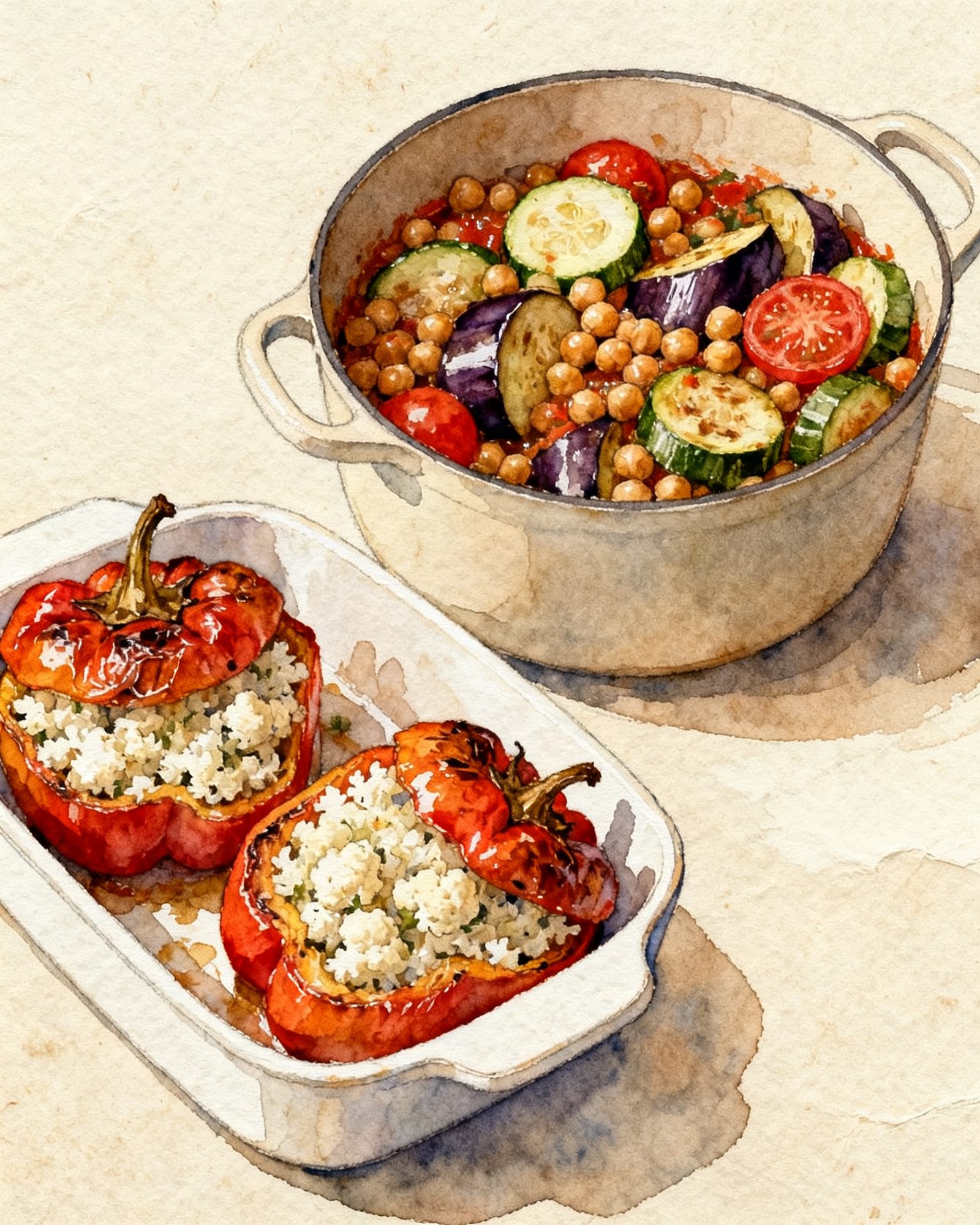
Makes About 7 cups, 4 servings
Ingredients
- 1/4 cup (60 ml) olive oil, divided
- 1 lb (455 g) eggplant (1 medium), cut into 3/4-inch cubes
- 2 medium (about 390 g) zucchini, cut into 1-inch pieces
- 1 large (about 150 g) yellow onion, diced
- 1 large (about 165 g) red bell pepper, cut into 3/4-inch pieces
- 4 cloves (about 12 g) garlic, minced
- 1 tsp dried thyme leaves
- 14.5 oz (410 g) canned diced tomatoes with their juice, one can
- 3 1/2 cups (530 g) canned chickpeas, drained and rinsed (two 15-ounce cans)
- 3/4 tsp fine salt, divided, plus more to taste
- 1/4 tsp ground black pepper
- 15 g fresh basil leaves, a large handful, torn
Equipment
- 5- to 6-quart Dutch oven or heavy pot
- Large bowl
- Colander
- Chef's knife and cutting board
- Wooden spoon or heatproof spatula
Method
Heat 2 tbsp of the olive oil in a 5- to 6-quart Dutch oven or heavy pot over medium-high heat until it shimmers. Add the eggplant and 1/4 tsp of the salt, spread it out, and cook, stirring every minute or two, until the cubes are browned on several sides and soft when pressed, 8 to 10 minutes. If the pot looks dry, turn the heat down a little rather than adding more oil: the eggplant gives some of the oil back as it softens. Transfer to a large bowl.
Add 1 tbsp of the oil, the zucchini and 1/4 tsp of the salt to the pot. Cook, stirring occasionally, until the zucchini is golden in spots but still firm in the center, 4 to 5 minutes. Add it to the bowl with the eggplant.
Reduce the heat to medium. Add the remaining 1 tbsp oil, the onion and the bell pepper and cook, stirring often, until the onion is soft and translucent and the pepper has softened, 6 to 8 minutes.
Add the garlic and thyme and stir for about 1 minute, until the garlic smells fragrant.
Add the diced tomatoes with their juice, the chickpeas, the remaining 1/4 tsp salt and the black pepper, and scrape up the browned bits from the bottom of the pot. Bring to a simmer, then reduce the heat to medium-low and simmer, uncovered, stirring now and then, until the tomatoes have cooked down into a thick sauce, about 15 minutes.
Return the eggplant and zucchini to the pot with any juices from the bowl and fold them in gently. Simmer for 5 to 10 minutes more, until the zucchini is tender but still holds its shape and the stew is thick rather than soupy.
Turn off the heat, taste and add more salt if it needs it, and stir in the torn basil. Serve hot or warm. Refrigerate leftovers within 2 hours.
Nutrition per serving
| Calories | 400 |
|---|---|
| Total fat | 18 g |
| Saturated fat | 2.5 g |
| Carbohydrate | 51 g |
| Fiber | 16 g |
| Total sugars | 18 g |
| Protein | 14 g |
| Sodium | 850 mg |
| Calcium | 150 mg |
| Iron | 3.3 mg |
Per serving, calculated from USDA FoodData Central values for the ingredients and amounts listed. Calories, fat, carbohydrate, fiber, sugars, protein and sodium are rounded with the FDA Nutrition Facts label rules; calcium is shown to the nearest 10 mg and iron to the nearest 0.1 mg. Brands differ, so treat the figures as estimates.
How these numbers were calculated
Each ingredient as weighed for the calculation and the USDA FoodData Central record its nutrients come from. Where USDA has no record for an ingredient (vegan butter, nutritional yeast, coconut sugar), the closest generic record is used and named here.
| Ingredient | Grams | USDA record |
|---|---|---|
| 1/4 cup (60 ml) olive oil, divided | 54 g | FDC 171413: Oil, olive, salad or cooking (SR Legacy). Weight from: USDA portion '1 cup' |
| 1 lb (455 g) eggplant (1 medium), cut into 3/4-inch cubes | 453.6 g | FDC 169228: Eggplant, raw (SR Legacy). Weight from: 1 lb = 453.6 g |
| 2 medium (about 390 g) zucchini, cut into 1-inch pieces | 392 g | FDC 169291: Squash, summer, zucchini, includes skin, raw (SR Legacy). Weight from: USDA portion '1 medium' |
| 1 large (about 150 g) yellow onion, diced | 150 g | FDC 170000: Onions, raw (SR Legacy). Weight from: USDA portion '1 large' |
| 1 large (about 165 g) red bell pepper, cut into 3/4-inch pieces | 164 g | FDC 170108: Peppers, sweet, red, raw (SR Legacy). Weight from: USDA portion '1 large (2-1/4 per pound, approx 3-3/4" long, 3" dia.)' |
| 4 cloves (about 12 g) garlic, minced | 12 g | FDC 169230: Garlic, raw (SR Legacy). Weight from: USDA portion '1 clove' |
| 1 tsp dried thyme leaves | 1 g | FDC 170938: Spices, thyme, dried (SR Legacy). Weight from: USDA portion '1 tsp, leaves' |
| 14.5 oz (410 g) canned diced tomatoes with their juice, one can | 411.1 g | FDC 170051: Tomatoes, red, ripe, canned, packed in tomato juice (SR Legacy). Weight from: 1 oz = 28.35 g |
| 3 1/2 cups (530 g) canned chickpeas, drained and rinsed (two 15-ounce cans) | 532 g | FDC 173801: Chickpeas (garbanzo beans, bengal gram), mature seeds, canned, drained, rinsed in tap water (SR Legacy). Weight from: USDA portion '1 cup drained, rinsed' |
| 3/4 tsp fine salt, divided, plus more to taste | 4.5 g | FDC 173468: Salt, table (SR Legacy). Weight from: USDA portion '1 tsp' |
| 1/4 tsp ground black pepper | 0.6 g | FDC 170931: Spices, pepper, black (SR Legacy). Weight from: USDA portion '1 tsp, ground' |
| 15 g fresh basil leaves, a large handful, torn | 15 g | FDC 172232: Basil, fresh (SR Legacy). Weight from: weight |
Ratatouille is the Provençal stew of eggplant, zucchini, peppers, onion and tomato, cooked in olive oil until the vegetables are soft and the juices have turned into a thick sauce. Adding chickpeas turns a side dish into a dinner that fills a bowl on its own. The version on the card above is made on the stovetop in one pot, and it works because the vegetables are cooked in stages: the eggplant and zucchini are browned first and set aside, the onion and pepper build the base, and everything meets in the tomato sauce only at the end, so each vegetable keeps its own shape and taste.
Traditional ratatouille contains no beans; it is a vegetable dish, often served as a side. Chickpeas are a modern addition, and a practical one: they stay whole through the simmer, take on the flavor of the tomato sauce and make the stew filling enough to serve on its own.
Why the vegetables cook in stages
The vegetables in ratatouille behave very differently in the pot. Eggplant is a sponge of air pockets: it soaks up oil at first, then softens and collapses until it is creamy all the way through. Zucchini is mostly water and goes from crisp to limp quickly. Onion and pepper need steady, moderate heat to turn sweet. If all of them simmer together from the start, the zucchini disintegrates long before the eggplant is cooked, and the whole pot turns into a uniform mush.
Browning in stages fixes this. High heat on the eggplant and zucchini colors their surfaces, which adds a roasted flavor a simmered vegetable never gets, and it drives off some of their water so they do not flood the sauce. Then the tomatoes and chickpeas simmer on their own for about 15 minutes, long enough for the tomatoes to break down and for the chickpeas to take on the flavor of the sauce. The browned vegetables go back in for the last 5 to 10 minutes, just long enough to finish softening and to heat through.
Cutting for even cooking
Size the pieces by how fast each vegetable cooks:
- Eggplant, 3/4-inch cubes. Smaller cubes soften all the way through in the time it takes the outside to brown.
- Zucchini, 1-inch pieces. Larger pieces are deliberate: zucchini cooks faster, and bigger chunks survive the final simmer without falling apart. Halve thin zucchini lengthwise and cut it into thick half-moons; quarter fat ones.
- Bell pepper, 3/4-inch pieces, and the onion diced to about the same size, so they soften together.
Leave the skin on the eggplant and zucchini. It holds the pieces together and gives the stew its color.
To salt the eggplant or not
Salting cubed eggplant before cooking draws out water and collapses some of its air pockets, so it soaks up less oil and browns a little faster. The recipe does not require it: the eggplant is salted as it goes into the pot, and a firm eggplant with tight, glossy skin cooks up mild. If you prefer a denser, less oily result, toss the cubes with about 1 teaspoon of salt and leave them in a colander for about 30 minutes, then rinse off the salt, pat the cubes very dry with a towel and leave out the 1/4 teaspoon of salt in step 1. It adds half an hour to the recipe. A light sprinkle of salt for a few minutes while you cut the other vegetables draws out too little water to make a difference.
Whichever way you go, resist adding more oil when the eggplant first drinks up the 2 tablespoons in the pot. Lower the heat slightly and keep stirring; as the cubes soften they release some of that oil again.
Canned or home-cooked chickpeas
Canned chickpeas are the quick route, and two 15-ounce cans give the 3 1/2 cups on the card. Drain them and rinse them in a colander so the stew tastes of tomato and herbs rather than of the canning liquid.
Home-cooked chickpeas work just as well. The University of Nebraska-Lincoln Extension says to use 1 3/4 cups of cooked, drained beans in place of one 15-ounce can, so measure 3 1/2 cups of your own. Cook them until completely tender before they go in: the same source advises adding acidic foods such as tomatoes only after beans are cooked, because acid can keep them from becoming tender. For soaking methods and cooking times, see how to cook dried beans and chickpeas.
Chickpeas are what make the stew a main course. The Dietary Guidelines for Americans, 2025-2030 name beans, peas, lentils and other legumes among the plant-sourced protein foods; for how they compare with tofu, lentils and grains, see the guide to plant-based protein.
How to tell when it is done
- The eggplant is creamy in the center when you press a cube against the side of the pot with a spoon, with no white, spongy core.
- The zucchini is tender when pierced with a knife but still has its shape and a little resistance at the center.
- The sauce is thick enough that a spoon dragged across the bottom of the pot leaves a clear trail for a moment. If it is soupy, simmer a few minutes longer uncovered before adding the basil.
The stew tastes better after it rests: the flavors settle and the sauce thickens as it cools, so it is a good dish to make a day ahead.
Substitutions and variations
- Yellow squash works in place of the zucchini, cut and cooked the same way.
- Peppers: any color works. Green bell pepper gives a sharper, more vegetal taste than red, yellow or orange.
- Herbs: 1 teaspoon of an herbes de Provence blend can replace the thyme. Fresh thyme also works; use about three times as much as dried. Parsley can stand in for basil, but basil is the classic finish.
- Beans: white beans such as cannellini or Great Northern can replace the chickpeas. They are softer, so fold them in gently.
- Spice: a pinch of red pepper flakes with the garlic adds heat without changing the character of the dish.
- Fennel: a thinly sliced fennel bulb, cooked with the onion and pepper, adds a mild anise sweetness.
- Oil-free: you can soften the onion and pepper in a few tablespoons of water or vegetable broth instead of oil, adding more as it evaporates. The eggplant and zucchini will not brown without fat, so they come out softer and the stew tastes more stewed than roasted, but it still works.
- Olives or capers: a handful of chopped olives or a spoonful of capers stirred in with the basil adds a salty, briny edge; taste before adding any more salt.
- What does not work well: frozen eggplant or zucchini, which release too much water to brown, and very large, seedy eggplants, which can be bitter and stay spongy.
Roasted instead of browned in the pot
Searches for chickpea ratatouille often mean the sheet-pan kind, where the vegetables are roasted instead of cooked on the stove. You can borrow that idea for the eggplant and zucchini without losing the thick tomato sauce. Toss the cubed eggplant and zucchini with 3 tablespoons of the oil and 1/2 teaspoon of the salt, spread them on two lined rimmed baking sheets with space between the pieces, and roast them in a hot oven, at the temperature you would use for roasted vegetables, turning once, until browned at the edges and tender. Meanwhile, follow steps 3 to 5 on the card in the pot with the remaining oil, then fold in the roasted vegetables at step 6.
Roasting takes less attention than browning in batches and gives drier, more caramelized edges; it uses the oven and two pans, and the eggplant comes out slightly firmer. Do not crowd a single pan with all the vegetables: they steam in their own water instead of browning, which is the same problem the stovetop staging is there to prevent.
Serving ideas
Spoon it over polenta, rice, couscous or pasta, or serve it with crusty bread to mop up the sauce. For chickpea ratatouille with pasta, cook short pasta such as penne or rigatoni, save a little of the cooking water, and toss the drained pasta with the hot stew, loosening it with a splash of the water until it coats the pasta. For a grain-free base, cauliflower rice takes about 10 minutes in a skillet. Ratatouille is also good warm or at room temperature, topped with a drizzle of olive oil. If you are cooking a bean-based dinner for a crowd, vegan bean chili uses the same build-the-base, then simmer approach.
Storage, reheating and freezing
Cool the stew and get it into the refrigerator within 2 hours of cooking, the limit USDA’s Food Safety and Inspection Service gives for leftovers; dividing it into shallow containers helps it cool quickly to 40°F or below. Refrigerated leftovers keep for 3 to 4 days.
Reheat portions on the stovetop or in the microwave until they reach 165°F, checked with a food thermometer, stirring once or twice so the center heats through. Add a splash of water if the sauce has thickened too much.
FoodSafety.gov lists 2 to 3 months in the freezer for soups and stews, and notes that freezer times are for quality only. After thawing, the eggplant and zucchini are softer, so frozen ratatouille is best used as a chunky sauce for pasta or polenta.
Common mistakes and how to fix them
- Gray, steamed eggplant: the pot was not hot enough or too crowded. Let the oil shimmer before the eggplant goes in, spread the cubes out, and do not stir constantly; they need contact with the pot to brown.
- Watery stew: the tomatoes did not cook down long enough before the vegetables went back in. Simmer uncovered until the sauce is thick, then add the eggplant and zucchini.
- Bland flavor: under-salting. Canned tomatoes and chickpeas vary in salt, so taste at the end and add a pinch at a time. A teaspoon of red wine vinegar or lemon juice stirred in at the end also brightens a flat stew.
- Burnt garlic: garlic added to a very hot pot browns in seconds and turns bitter. Lower the heat to medium before the onion goes in, and add the garlic only once the onion is soft.
Allergy and ingredient notes
As written, the recipe contains none of the common allergens named here: no tree nuts, peanuts, soy, wheat or gluten, sesame or coconut. Check the labels on canned tomatoes and chickpeas if you need to avoid foods processed alongside other allergens, and remember that bread, pasta or couscous served alongside contain wheat.
Common questions
Do I have to salt the eggplant before cooking it?
No. In this recipe the eggplant is seasoned as it browns, and a firm, glossy eggplant cooks up mild without salting first. If you want it denser and less oily, salt the cubes generously and let them drain in a colander for about 30 minutes, then rinse, pat them very dry and leave out the 1/4 teaspoon of salt in step 1. A quick sprinkle of salt for a few minutes does very little.
Why does my ratatouille turn to mush?
Usually because all the vegetables simmered together from the start. Zucchini softens much faster than eggplant, so by the time the eggplant is tender the zucchini has collapsed. Browning the eggplant and zucchini separately and folding them back into the tomato sauce for only the last few minutes keeps the pieces whole.
Can I use dried chickpeas instead of canned?
Yes. The University of Nebraska-Lincoln Extension says to use 1 3/4 cups of cooked, drained beans where a recipe calls for one 15-ounce can, so use 3 1/2 cups of home-cooked chickpeas in place of the two cans. Cook them until fully tender before they go into the stew, because acidic foods such as tomatoes can keep beans from becoming tender.
Can I freeze chickpea ratatouille?
Yes. FoodSafety.gov gives 2 to 3 months in the freezer for soups and stews, a guide to quality rather than safety. The zucchini and eggplant soften further after thawing, so the texture is closer to a thick sauce, which is good over pasta or polenta.
Can you put chickpeas in ratatouille?
Yes. Classic Provençal ratatouille is vegetables only, so chickpeas are a modern addition rather than part of the traditional dish, but they suit it well: they hold their shape through the simmer, soak up the tomato sauce and turn a side dish into a main course. Add them with the tomatoes so they have time to take on the flavor of the sauce.
What do you serve with chickpea ratatouille?
Crusty bread, polenta, rice, couscous or pasta all work, and so does cauliflower rice for a grain-free base. It is also good at room temperature as part of a spread, or spooned onto toast.
Sources
Read next
Vegan bean chili: thick, smoky and made with three beans
A thick vegan chili with kidney, black and pinto beans: blooming the spices, what thickens it, canned vs. dried beans done safely, toppings and freezing.
Stuffed peppers with cauliflower rice and black beans
Vegan stuffed peppers with a spiced filling of cauliflower rice, black beans, corn and tomato: par-baked halves, a filling that stays dry, make-ahead tips.
Vegan margherita pizza with melting cashew mozzarella
A home-oven vegan margherita pizza: an easy yeast dough, a thick quick tomato sauce, a cashew mozzarella that melts and browns, and how to avoid a soggy center.
How to make cauliflower rice that is fluffy, not mushy
How to make cauliflower rice with a box grater or food processor, cook it dry in a skillet or roast it, season it, freeze it and avoid mushy, watery rice.
Banana nice cream, plus a blue spirulina version
How to turn frozen bananas into smooth soft-serve: ripeness, slicing and freezing, blending with almost no liquid, a blue spirulina version and more flavors.